Summary
Few medical conditions command immediate attention quite like a kidney stone. One moment you feel fine, and the next, a sharp, stabbing pain radiates through your back and side, bringing you to your knees. If you currently suffer from this condition, you have one goal: getting that stone out of your body as quickly and painlessly as possible.
However, passing the stone is only half the battle. Once you experience a kidney stone, your risk of developing another one significantly increases. This article serves as your tactical guide. We explore exactly how these painful crystals form, the most effective methods to pass them safely, and five evidence-based strategies to ensure you never have to endure this pain again.
Where do kidney stones come from?
To defeat the enemy, you must first understand it. A kidney stone is not a foreign object that enters your body; it is a creation of your own chemistry. Your kidneys act as the body's master filtration system. They filter your blood to remove waste and extra water, creating urine.
Normally, your urine contains chemicals that prevent crystals from forming. However, when you do not drink enough fluids or when your urine contains too much waste (like calcium, oxalate, and uric acid), the system fails. The urine becomes "super-saturated." In this environment, minerals and salts no longer stay dissolved. Instead, they clump together.
These clumps start as microscopic crystals. Over time, they attract more material and grow into hard, rock-like masses. These are kidney stones. They range in size from a grain of sand to a golf ball.
The Four Main Culprits:
While all stones hurt, they form for different reasons.
- Calcium Oxalate Stones: These are the most common. They form when calcium combines with oxalate (a substance found in food) in the urine.
- Uric Acid Stones: These form when your urine is too acidic, often due to a high-protein diet or chronic dehydration.
- Struvite Stones: These usually develop in response to a urinary tract infection (UTI) and can grow rapidly.
- Cystine Stones: These stem from a hereditary disorder that causes the kidneys to excrete too much of a specific amino acid.
The stone stays in the kidney where it formed, often without causing pain. The agony begins when the stone moves into the ureter—the narrow tube connecting the kidney to the bladder.
How to pass a kidney stone?
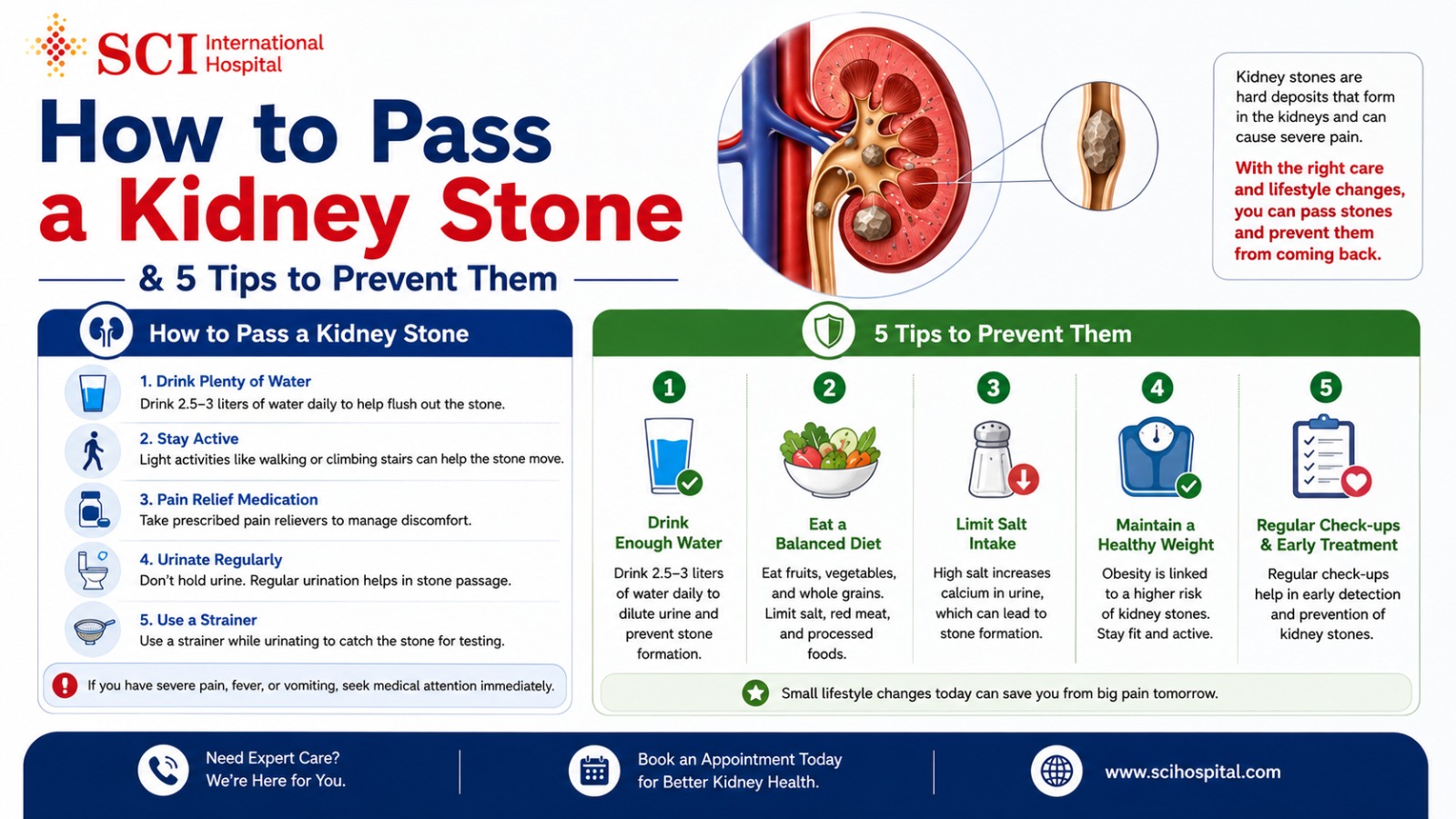
If your doctor confirms that the stone is small enough to pass on its own, your primary job involves helping your body flush it out. This process requires patience and discipline. Here is your action plan.
- Hydrate Aggressively
Water is your most powerful tool. You must create a high volume of urine to physically push the stone through the urinary tract. Aim to drink 2 to 3 liters (roughly 8 to 10 glasses) of water daily. Ideally, your urine should look clear or pale yellow. If it looks dark, you are not drinking enough. - Use Medical Expulsive Therapy (Alpha-Blockers)
Consult your doctor about medications known as alpha-blockers (such as tamsulosin). These drugs relax the muscles in your ureter. By relaxing these muscles, the tube widens slightly, allowing the stone to pass more easily and with less pain. - Manage the Pain
Pain management is crucial. Over-the-counter pain relievers like ibuprofen (Advil) or naproxen sodium (Aleve) help in two ways: they reduce the pain, and they reduce the inflammation in the ureter caused by the scratching stone. However, if the pain becomes unbearable, visit the emergency room immediately. - Add Lemon to Your Water
Lemons contain citrate, a chemical that prevents calcium stones from forming and helps break up small existing stones. Squeezing fresh lemon into your water adds a chemical advantage to your hydration strategy. - Stay Active
While you might want to curl up in bed, gentle movement helps. Gravity and physical vibration assist the stone in moving downward toward the bladder. Walking is an excellent low-impact activity to encourage movement.
When to Seek Emergency Help:
Do not try to be a hero. Go to the hospital if you experience:
- Pain so severe you cannot sit still or find a comfortable position.
- Nausea and vomiting that prevents you from keeping water down.
- Fever and chills (this indicates an infection, which is life-threatening when combined with a blockage).
- Blood in your urine.
How long does it take to pass a stone?
This is the most common question patients ask, and the answer depends entirely on the size and location of the stone.
Size Matters:
- Small Stones (Under 4mm): You have excellent odds here. About 80% of stones this size pass on their own. It typically takes anywhere from a few days to 31 days.
- Medium Stones (4mm to 6mm): The odds drop to about 60%. These usually require medication (alpha-blockers) to assist the process. It may take up to 45 days.
- Large Stones (Over 6mm): These rarely pass naturally (only about 20% chance). They usually require surgical intervention, such as shock wave lithotripsy (using sound waves to break the stone) or ureteroscopy.
Location Matters:
A stone sitting close to the bladder passes much faster than a stone stuck high up near the kidney.
If a stone does not pass within 4 to 6 weeks, or if it causes complications, doctors generally recommend removing it surgically to prevent permanent kidney damage.
How to prevent kidney stones: 5 tips
Once you pass a stone, you never want to experience it again. Unfortunately, if you have had one, your risk of getting another within 5 to 7 years is nearly 50%. You can slash this risk significantly by altering your lifestyle.
Here are the five most effective ways to prevent recurrence.
1. Drink Water Like It’s Your Job
We mentioned hydration for passing a stone, but it is even more critical for prevention. Think of your urine as a solution. If you have too much powder (minerals) and not enough water, the powder clumps. If you add more water, the powder stays dissolved.
The Goal: You need to produce at least 2.5 liters of urine a day. This usually means drinking about 3 liters of fluid. Carry a water bottle everywhere. If you exercise or live in a hot climate, drink even more.
2. Eat Calcium-Rich Foods (Don't Skip Them!)
This is the biggest myth in kidney stone prevention. Because most stones are made of calcium, people assume they should stop eating calcium. This is a mistake.
If you eat too little calcium, oxalate levels in your body rise. Normally, dietary calcium binds with oxalate in your stomach and intestines, leaving your body through stool. If you don't eat calcium, the oxalate has nothing to bind to in the gut, so it travels to the kidneys and forms stones.
The Strategy: Eat calcium-rich foods like milk, yogurt, and cheese during meals. However, avoid calcium supplements unless your doctor prescribes them, as supplements can increase stone risk.
3. Slash Your Sodium Intake
Salt is a major enemy of kidney health. When you eat too much sodium, your kidneys must work harder to excrete it. Unfortunately, calcium follows sodium. High sodium intake forces your kidneys to push more calcium into the urine. This extra calcium increases the risk of stone formation.
The Strategy: Avoid processed foods, canned soups, and fast food. Aim for less than 2,300 mg of sodium per day. If you have a history of stones, try to stay under 1,500 mg.
4. Limit Animal Protein
Red meat, poultry, eggs, and seafood increase the level of uric acid in your body. High uric acid leads to uric acid stones. Furthermore, a high-protein diet reduces the level of citrate in your urine (the chemical that prevents stones).
The Strategy: You don't have to become a vegetarian, but you should treat meat as a side dish rather than the main course. Limit your meat intake to a portion the size of a deck of cards per meal. Replace some animal proteins with plant-based alternatives like beans, lentils, and nuts.
5. Watch Your Oxalate Intake
If you form calcium-oxalate stones, you must monitor foods high in oxalates. Oxalate is a natural substance found in many healthy plants.
High-Oxalate Foods: Spinach, rhubarb, almonds, beets, and cocoa powder.
The Strategy: You do not need to eliminate these healthy foods entirely. Instead, use the "Calcium Pairing" trick. If you eat spinach (high oxalate), drink a glass of milk (high calcium) with it. The calcium binds to the oxalate in your stomach, preventing it from reaching your kidneys.
Conclusion
Passing a kidney stone is a test of endurance, but it also serves as a loud wake-up call from your body. The pain signals a chemical imbalance that you have the power to correct.
While the immediate goal involves hydration, pain management, and medical guidance to pass the stone, the long-term victory lies in prevention. By staying hydrated, balancing your calcium intake, reducing salt, and moderating animal protein, you create an environment in your kidneys where stones cannot survive.
Do not wait for the next attack. Implement these changes today, consult your urologist for a personalized metabolic evaluation, and take control of your kidney health.