Summary
Kidney stones are one of the most painful conditions a person can endure. Often described as sharper than childbirth or a broken bone, this condition affects millions of people annually. However, many patients make a critical mistake: they assume all kidney stones are the same.
In reality, a kidney stone is not just a rock; it is a specific chemical compound that forms due to a unique imbalance in your body. Treating a kidney stone without knowing its type is like trying to unlock a door with the wrong key. One stone forms because you eat too much spinach; another forms because you have a genetic disorder; yet another forms because of a hidden infection.
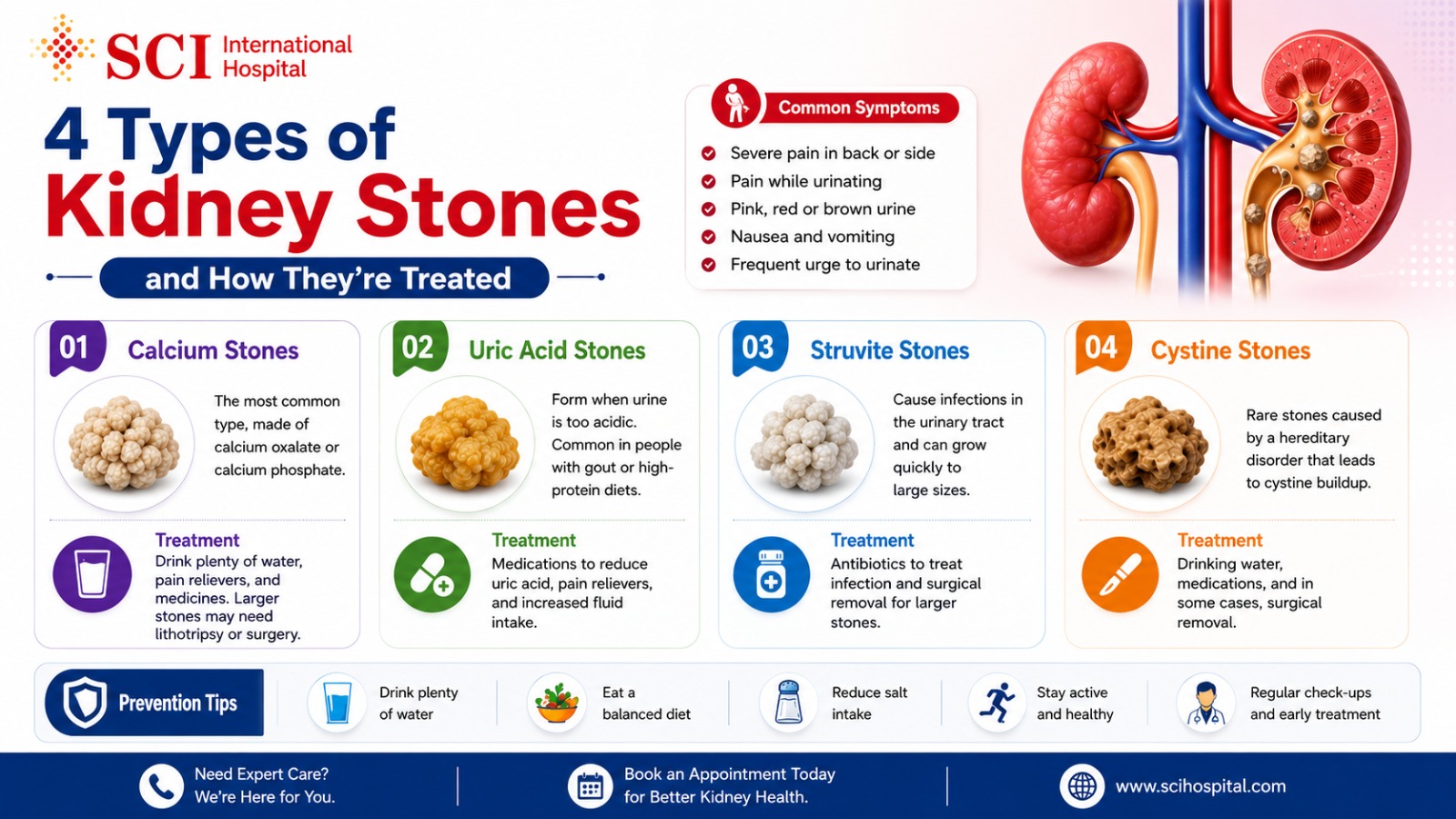
Understanding the four main types of kidney stones—Calcium, Uric Acid, Struvite, and Cystine—empowers you to take the right steps for treatment and prevention. This guide breaks down exactly how each stone forms, how doctors treat them, and how you can stop them from returning.
- Calcium Oxalate or Calcium Phosphate Stones
These are the most common offenders. Roughly 80% of all kidney stones fall into the calcium category. Within this group, Calcium Oxalate stones are the most frequent, while Calcium Phosphate stones occur less often but are rising in prevalence.
Why They Form:
Calcium stones do not form simply because you eat too much calcium. In fact, cutting calcium from your diet often causes them!
- Calcium Oxalate: These form when your urine contains high levels of calcium, oxalate, or uric acid, and too little fluid. Oxalate is a natural substance found in food. When you eat oxalate-rich foods (like spinach or nuts) without calcium, your body absorbs the oxalate, sends it to the kidneys, and it binds with calcium there to form stones.
- Calcium Phosphate: These typically form when your urine is too alkaline (high pH). They are often linked to metabolic conditions like renal tubular acidosis or hyperparathyroidism.
How They Are Treated:
- Small Stones: Doctors usually prescribe aggressive hydration and alpha-blockers (medication to relax the ureter) to help you pass the stone naturally.
- Large Stones: If the stone is too large, urologists use Shock Wave Lithotripsy (SWL) to break it into pieces using sound waves, or Ureteroscopy, where they insert a camera and laser into the ureter to dust the stone.
- Prevention (The Real Treatment): To prevent recurrence, you must adjust your diet.
- Hydrate: Drink 3 liters of water daily.
- Pair Foods: Eat calcium-rich foods with oxalate-rich foods so they bind in the stomach, not the kidneys.
- Reduce Sodium: High salt intake forces kidneys to excrete more calcium, which causes stones.
- Uric Acid Stones
Uric acid stones are the second most common type. They are distinct because they are "radiolucent," meaning they often do not show up on standard X-rays. Doctors usually need a CT scan to see them.
Why They Form:
These stones develop when your urine is consistently too acidic. High acidity creates the perfect environment for uric acid to crystallize.
- Diet: A diet high in animal protein (red meat, poultry, shellfish) increases uric acid levels in the body.
- Dehydration: Not drinking enough water concentrates the acid.
- Gout: People with gout or those undergoing chemotherapy are at higher risk.
How They Are Treated:
Uric acid stones are unique because doctors can sometimes dissolve them without surgery.
- Dissolution Therapy: By prescribing medications like potassium citrate or sodium bicarbonate, doctors can alkalize (lower the acidity of) your urine. As the pH rises, the stone may dissolve back into the urine.
- Dietary Changes: You must restrict high-purine foods like organ meats, sardines, and red meat.
- Medication: Doctors often prescribe Allopurinol, a drug that lowers the amount of uric acid your body produces.
- Surgery: If the stone is large and does not dissolve, standard removal procedures like lithotripsy or ureteroscopy apply.
- Struvite Stones
Struvite stones (also known as infection stones) are dangerous and unpredictable. They are more common in women than men and can grow rapidly, often becoming massive "staghorn" calculi that fill the entire kidney.
Why They Form:
These stones form in response to a urinary tract infection (UTI). Specific bacteria produce ammonia, which raises the pH of your urine, making it alkaline. This alkaline environment allows magnesium, ammonium, and phosphate to crystallize rapidly into stones. Unlike other stones, these are not caused by diet.
How They Are Treated:
Struvite stones rarely dissolve or pass on their own because they are too large and jagged.
- PCNL (Percutaneous Nephrolithotomy): This is the gold standard for large struvite stones. The surgeon makes a small incision in your back and inserts a scope directly into the kidney to break up and suction out the stone.
- Antibiotics: Since bacteria live inside the stone, you need strong antibiotics to clear the infection. If you leave even a small fragment of the stone behind, the bacteria can regrow the stone quickly.
- Prevention: The primary goal is to keep the urine free of bacteria. For patients prone to chronic UTIs, doctors may prescribe low-dose, long-term antibiotics or acidifying agents to keep urine pH low.
- Cystine Stones (Rare)
Cystine stones are the rarest type, affecting only about 1 in 7,000 people. They represent a lifelong challenge for those who have them.
Why They Form:
These stones are genetic. They result from a hereditary disorder called cystinuria. This condition causes the kidneys to leak excessive amounts of a specific amino acid called cystine into the urine. Since cystine does not dissolve well in urine, it creates crystals and stones. This condition often appears in childhood or the teenage years.
How They Are Treated:
Cystine stones are notoriously hard and difficult to break.
- Advanced Surgery: Because they resist shock wave lithotripsy (SWL), doctors often jump straight to laser ureteroscopy or PCNL surgery to remove them.
- Dilution: Patients with cystinuria must drink massive amounts of water—often 4 liters or more per day—to dilute the cystine.
- Medication: Doctors prescribe specific drugs (like penicillamine or tiopronin) that bind to cystine and help it dissolve in urine. These medications often have side effects and require careful monitoring.
What's the worst type of kidney stone to have?
While "worst" is subjective, most urologists consider Struvite stones the most dangerous and Cystine stones the most difficult to manage.
- Struvite Stones: These are the most dangerous because they grow silently. You might not feel pain until the stone takes over the entire kidney. They can lead to severe kidney infections, sepsis (blood poisoning), and permanent loss of kidney function if untreated.
- Cystine Stones: These are the most frustrating. Because the cause is genetic, patients often form stones repeatedly throughout their lives. They frequently require multiple surgeries starting at a young age, which can lead to kidney scarring over time.
Which type of kidney stone is painful?
Here is a surprising fact: The chemical composition of the stone does not determine the pain level.
A calcium stone does not hurt "more" than a uric acid stone. Pain depends entirely on size, location, and obstruction.
- Blockage: Pain occurs when a stone blocks the flow of urine. This causes the kidney to swell (hydronephrosis) and spasm. A tiny 4mm stone that blocks the ureter causes significantly more pain than a massive 2cm stone sitting quietly in the bottom of the kidney.
- Movement: A rough, jagged stone moving through the narrow ureter scratches the delicate lining, causing blood in the urine and intense cramping.
Regardless of whether you have a calcium, uric acid, struvite, or cystine stone, the physical symptoms—back pain, nausea, and vomiting—remain the same during an attack.
Are different types of kidney stones treated differently?
The answer is Yes and No.
The "No" (Surgical Removal):
When a stone is stuck and causing an emergency, the removal methods are largely the same. Whether it is calcium or uric acid, if it blocks the kidney, the surgeon uses the same tools—Shock Waves, Lasers, or Scopes—to physically remove the blockage.
The "Yes" (Medical Management and Prevention):
This is where the difference matters most. Prevention is highly specific to the stone type.
- Calcium Stone Prevention: Focuses on lowering sodium and pairing calcium with food.
- Uric Acid Stone Prevention: Focuses on alkalizing the urine and reducing meat intake.
- Struvite Stone Prevention: Focuses on treating infections and keeping the urinary tract sterile.
- Cystine Stone Prevention: Focuses on massive hydration and specialized genetic medications.
If you treat a uric acid stone former with the diet plan for a calcium stone former, you will fail. This is why saving the stone for analysis is crucial.
Conclusion
A kidney stone is a message from your body that your chemical balance is off. While the immediate goal is always pain relief and removal, the long-term goal is understanding the type of stone you produce.
Do not guess. If you pass a stone, catch it. If you need surgery, ask your doctor to send the fragments to the lab. Knowing whether you are dealing with Calcium, Uric Acid, Struvite, or Cystine is the only way to create a targeted defense plan. With the right diagnosis, hydration, and medical guidance, you can stop the cycle of formation and keep your kidneys stone-free.