A kidney stone may remain in the kidney for a period of time, or it may be able to move into the ureter and cause extreme discomfort. The next step is determined by the specific stone. Certain stones can be monitored for a time, while others require removal. If a procedure is required, there are terms like RIRS, PCNL, and Laser URSL. Although all three are utilized to eliminate stones, they're not identical procedures. The primary difference lies in the location of the stone, how the doctor gets to it, and the amount of stone that must be removed.
Key Differences in Procedure and Access
These names can sound complicated, but the basic idea is quite simple.
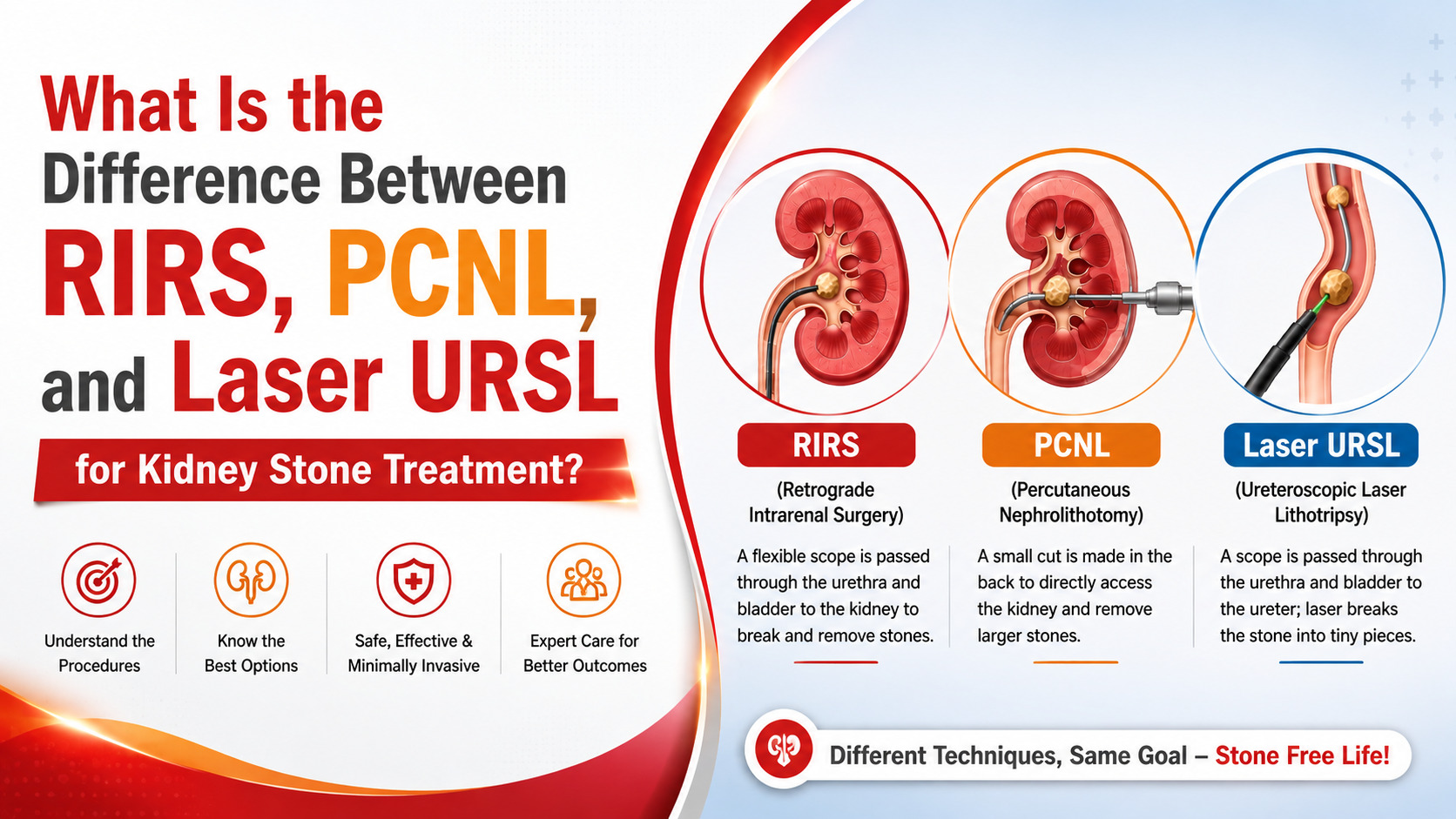
RIRS (Retrograde Intrarenal Surgery) is mainly used for stones inside the kidney. A thin, flexible scope is passed through the urinary passage and guided into the kidney. The stone is then broken into small pieces, usually with a laser. Since the scope enters through the natural urinary passage, there is no cut on the skin.
PCNL (Percutaneous Nephrolithotomy) uses a different route. The surgeon makes a small opening in the back to reach the kidney directly. Special instruments are then used to break and remove the stone. It is commonly considered when the stone is large or complex, and a larger amount of stone needs to be cleared.
Laser URSL (Ureteroscopic Removal of Stone) is generally used for stones in the ureter. A thin ureteroscope is passed through the urinary passage to reach the stone. A laser breaks the stone into smaller pieces, which can then be removed or allowed to pass in the urine.
Comparison of Stone Size, Recovery, and Use
The difference becomes easier to understand when you think about the location of the stone. RIRS reaches the kidney from inside the urinary tract. PCNL reaches the kidney directly through the back. Laser URSL follows the urinary tract to reach a stone in the ureter.
When Is RIRS Used for Kidney Stones?
RIRS can be a good option when a stone inside the kidney needs active treatment and can be reached safely with a flexible ureteroscope.
One of its main advantages is that there is no external incision. The laser can break the stone into smaller fragments, and the urologist may remove some of these fragments during the procedure.
RIRS has also become an important option for kidney stones because modern flexible scopes and laser technology allow the urologist to reach different parts of the kidney. However, very large or complex stones may need another approach, and some patients may require more than one procedure to achieve complete clearance.
If you want to understand the available options in more detail, you can also read about kidney stone treatment at SCI Hospital.
When Is PCNL Considered?
PCNL is usually considered when the kidney contains a large or complex stone burden.
Instead of passing an instrument all the way through the urinary passage, the surgeon creates a small access point through the back and reaches the kidney directly. This provides better access when a substantial amount of stone needs to be removed.
PCNL is also commonly used for complex kidney stones, including some staghorn stones. Current EAU guidance continues to recommend PCNL as an important treatment for larger renal stones and complex stone disease.
The trade-off is that PCNL involves a small incision, so recovery can be different from RIRS or URSL.
When Is Laser URSL Used?
Laser URSL is mainly used when the stone is in the ureter, the narrow tube that carries urine from the kidney to the bladder.
A ureteric stone may cause intense pain, vomiting, blood in the urine, or blockage of urine flow. If it is not likely to pass on its own or is causing problems, the urologist may recommend ureteroscopy with laser treatment.
The procedure is performed through the natural urinary passage, so there is no incision on the back. A temporary ureteric stent may be placed in some cases after the procedure. Whether a stent is required depends on the individual situation and the procedure performed.
Which One Is Better: RIRS, PCNL, or Laser URSL?
There is no single procedure that is automatically best for every kidney stone.
A stone inside the kidney may be suitable for RIRS, while a large or complex kidney stone may be better treated with PCNL. If the stone has moved into the ureter, Laser URSL may be the more suitable approach.
The decision is based on factors such as:
- Size of the stone
- Exact location
- Number of stones
- Kidney anatomy
- Urinary blockage
- Infection
- Previous stone treatment
- Overall health
This is why two people with kidney stones may receive different treatment recommendations. The 2026 EAU guidelines also emphasise choosing the procedure according to stone characteristics and the patient's individual situation rather than following one fixed treatment for everyone.
What Is Recovery Like After These Procedures?
Recovery depends on the procedure and the patient's condition.
RIRS and Laser URSL do not require an external incision, so many patients can return to normal activities relatively quickly. PCNL involves a small opening in the back, so recovery may take longer.
Some patients may have a ureteric stent after RIRS or URSL. It can cause temporary symptoms such as frequent urination, discomfort, or mild blood in the urine. Your urologist will tell you when the stent should be removed.
The actual recovery time should always be discussed with your treating doctor because it can vary according to the stone, procedure, and individual health.
How Is the Right Kidney Stone Treatment Chosen?
A scan is an important part of this decision. Your urologist may use ultrasound or CT imaging to understand the stone's size, location, and effect on the urinary system.
For example, the same treatment may not be suitable for a stone in the lower part of the kidney and a stone lodged in the ureter. Similarly, a small stone and a large stone may require very different approaches.
At SCI International Hospital, patients can be evaluated for different minimally invasive kidney stone treatment options. Dr. Gautam Banga, Consultant Urologist, has expertise in RIRS and PCNL for kidney stone removal, along with other minimally invasive urological procedures. You can also explore more about urology services at SCI Hospital for detailed evaluation and treatment options.
Conclusion
RIRS, PCNL, and Laser URSL are all useful options for kidney stone treatment, but they are designed for different situations. RIRS is mainly used to reach stones inside the kidney; PCNL provides direct access to the kidney for larger or complex stones, while Laser URSL is commonly used for stones in the ureter. The right choice depends on the stone and the patient's condition. A proper scan and consultation with an experienced urologist can help determine which treatment is most appropriate.
FAQs related to the difference between RIRS, PCNL, and Laser URSL.
Que- Are RIRS superior to PCNL?
Ans- In every situation, however. The RIRS is a good option for kidney stones of all kinds; however, PCNL is typically considered for larger or more complicated stones.
Que- Can laser URSL be used to treat kidney stones?
Ans- Laser URSL is used primarily to treat stones in the urinary tract. Stones in the kidney can be treated using RIRS or a different procedure that is suitable.
Que- What is the procedure used to treat the large kidney stone?
Ans- PCNL is typically thought of as a treatment to be a solution for complicated or large kidney stones because it allows surgeons direct access to the kidney, and permits more stone that can be removed.
Que- Does RIRS require an incision?
Ans- No. RIRS is administered via the natural urinary tract and is not a requirement for cutting the external skin.
Que- Does Laser URSL use a laser?
Ans- Yes. Lasers are commonly employed during ureteroscopy to break up the stones into pieces.
Que- Are kidney stones likely to return after treatment?
Ans- Yes. The removal of a stone doesn't mean that it will not develop in the future. Your urologist might suggest fluid intake, changes to your diet, as well as other measures to prevent the formation of stones based on the nature and the cause of stones.
Que- Which is better, RIRS or URS?
Ans- Neither is universally better. URS (Ureteroscopy) is commonly used to treat stones located in the ureter, while RIRS (Retrograde Intrarenal Surgery) is a specialised form of ureteroscopy used to reach and treat stones inside the kidney. The choice depends mainly on the stone’s location, size, number, and hardness.
Que- What is the safest procedure for kidney stone removal?
Ans- The safest kidney stone treatment depends on the stone’s size, location, composition and your overall health. RIRS, ureteroscopy and ESWL are minimally invasive options commonly used for suitable stones. Your urologist will recommend the safest approach after evaluating the stone and your medical condition.
Que- Which is better, PCNL or ureteroscopy?
Ans- Neither procedure is better for every patient. Ureteroscopy or RIRS uses the natural urinary passage and is generally preferred for many small to medium-sized stones. PCNL involves a small incision in the back and is often recommended for larger or complex kidney stones, particularly stones larger than 2 cm or staghorn stones. The final choice depends on the stone’s size, location and complexity.