“Will I be able to have a normal delivery?” This question often comes up during pregnancy, sometimes quite early. And it is understandable. Most women want to know what labour will be like, how painful it may be, and how quickly they will recover.
However, normal delivery is not the same. C-section isn't always a decision that is made prior to. It all depends on how your pregnancy develops, the baby's position, and what happens during labor. Vaginal births can be planned; however, if a problem arises, a C-section could be the best option to give birth.
What Happens in a Normal Delivery?
A vaginal or normal delivery signifies that the baby is born through the birth canal and does not require abdominal surgery. The labor process begins with contractions. The cervix opens gradually, and the baby falls towards the floor to give birth.
If the pregnancy isn't complicated and both the mother and the baby are healthy, vaginal birth is typically thought of first. There isn't a surgical abdominal injury, and getting back on your feet in a short time is usually quicker.
It's not simple for all. Contractions may be painful, labor can last for a long time, and vaginal tears or episiotomies can occur.
Preparing for childbirth also starts well before labour. Regular antenatal visits, appropriate activity, and knowing what to expect can make this period easier to manage. SCI Hospital's guide on tips for normal delivery covers some of these practical aspects of pregnancy preparation.
What Happens During a C-Section?
A C-section or cesarean delivery is surgery. The baby is delivered through an incision in the abdomen and uterus while the mother is under anaesthesia.
Some C-sections are planned. Others aren't.
For instance, you may go into labour expecting a vaginal birth, but the baby's heart rate may become concerning or labour may stop progressing as expected. In that situation, the plan can change.
This is one reason a C-section shouldn't simply be seen as a delivery that happens when a woman “cannot have a normal birth.” Sometimes it is the safer medical decision.
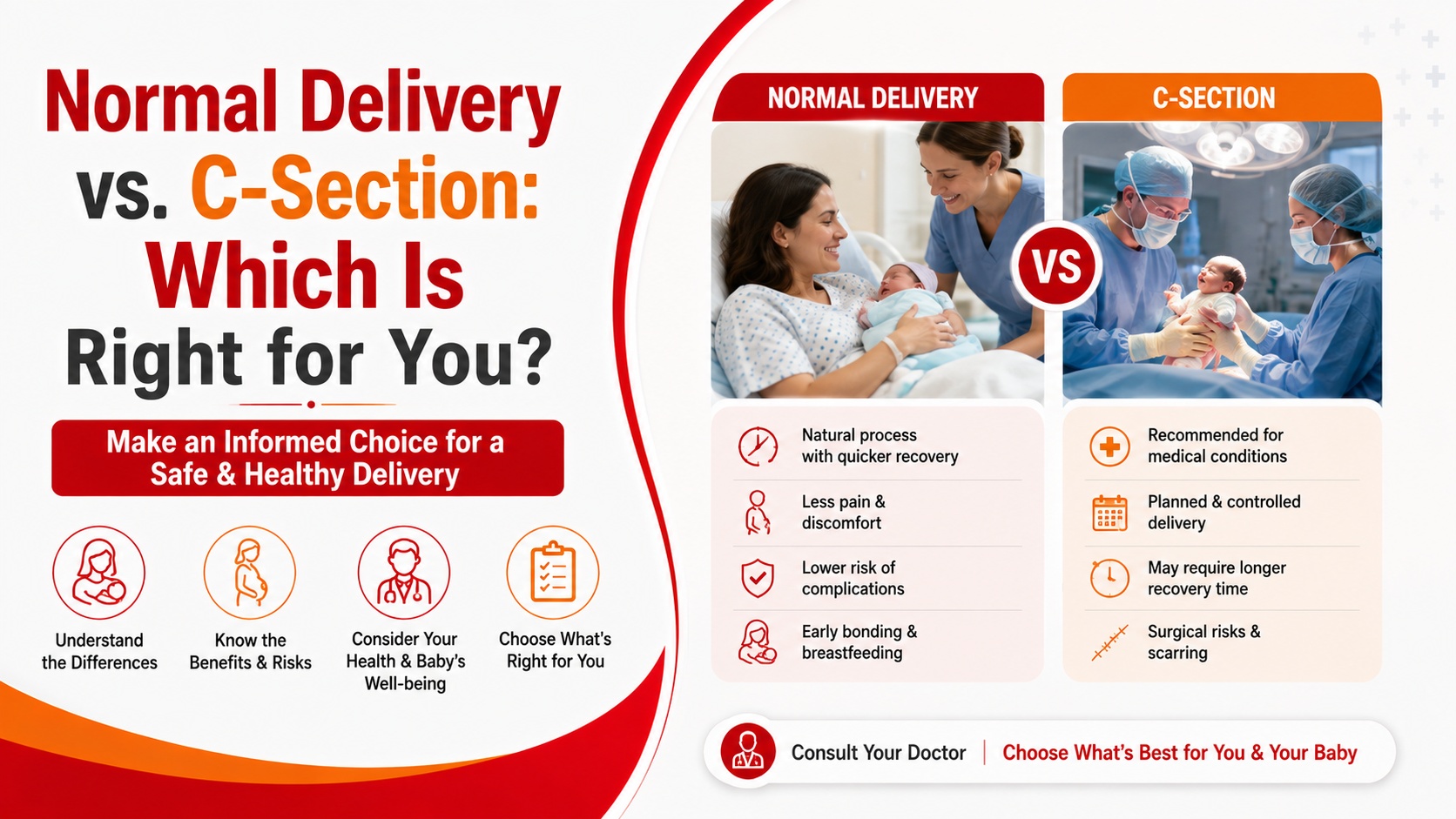
Normal Delivery vs. C-Section: What Actually Changes?
These are general differences, not a prediction of how one particular delivery will go. Two women having the same type of delivery can have quite different experiences.
Why Is Normal Delivery Often Preferred When It Is Safe?
One obvious reason is recovery. Without abdominal surgery, women can generally move around sooner and the hospital stay tends to be shorter. It also avoids risks that come specifically with surgery, such as wound infection and some complications that can matter in later pregnancies.
For the baby, passing through labour and vaginal birth also involves normal physiological changes that help with the transition after birth.
Still, “preferred” should not be confused with “must happen.” Trying to continue vaginal labour when it is no longer safe defeats the whole purpose.
When Can a C-Section Be the Better Option?
There are situations where surgery may offer a safer route for delivery. These can include:
- The baby is breech or in another position that makes vaginal birth difficult
- The placenta is covering the cervix
- The baby's condition becomes concerning during labour
- Labour is not progressing despite appropriate management
- Certain multiple pregnancies
- Some maternal health problems
- Certain complications related to a previous C-section or uterine surgery
Sometimes the reason is known before labour begins. At other times, it only becomes clear once labour is underway.
This is why maternity care needs the ability to manage both normal and cesarean deliveries, rather than treating them as two competing deliveries. SCI's Obstetrics & Gynaecology department provides pregnancy care, high-risk pregnancy management, normal delivery, and cesarean delivery.
What About Pain and Recovery?
This is where two experiences diverge the most.
When a vaginal birth occurs, the majority of the pain occurs during labor. There may be some tenderness afterward, particularly when there are stitches or tears; however, recovery is generally faster.
A C-section is a different procedure. Anaesthesia helps to reduce discomfort during the procedure; however, once it has worn off, abdominal cuts may make getting up and coughing, laughing, or even changing positions uncomfortable for a few minutes.
Therefore, saying "normal delivery is painful and C-section is painless" isn't necessarily true. The pain is felt at different levels.
The recovery process also varies. Some women may be comfortable immediately after vaginal birth, and another woman may require more time due to tears or labour that is painful. The same variation in individuals occurs following a C-section.
How Will Your Doctor Decide Which Delivery Is Safer?
Doctors don't decide this from one factor alone.
As the pregnancy progresses, they look at the baby's position and growth, the placenta, the mother's health, and any complications that have developed. Near delivery, these findings help shape the birth plan.
Then labour adds another set of information. How the cervix is opening, how the baby is moving down, and how the baby's heart rate is responding can all affect what happens next.
A previous C-section is another factor, but it doesn't automatically answer the question either. Some women may be suitable for vaginal birth after a previous C-section, while for others, another C-section may be advised.
This is also where the discussion with your obstetrician becomes more useful than comparing your pregnancy with someone else's. Dr. Ruchi Tandon, Consultant Obstetrician & Gynaecologist at SCI Hospital, manages maternal care and normal vaginal deliveries; her SCI profile also lists C-section among the services offered.
So, Is Normal Delivery or C-Section Better for You?
If the pregnancy is not complicated and the baby is in a safe position, and labor is proceeding safely the vaginal delivery method is typically preferred since it does not require major operations and the recovery process is usually faster.
There are also pregnancies. The answer is different.
If the placenta has obstructed the birth canal or the baby's position is not suitable, the fetal health is a concern or labour isn't progressing in a safe manner, a C-section could be the best choice.
This is the only difference that's important. The goal isn't to avoid the possibility of a C-section or to plan one if there is no medical reason. The safest delivery is one that matches what's happening to the baby and mother at the time.
SCI IVF's maternity care in Delhi also covers antenatal monitoring and both normal and C-section delivery, including the possibility that decisions may need to change according to clinical findings during labour.
Conclusion
Normal delivery usually comes with a shorter recovery and avoids abdominal surgery. A C-section takes longer to recover from, but there are times when surgery is exactly what makes childbirth safer. And sometimes that decision isn't made until labour has already started. Regular antenatal care gives your doctor a better picture of your pregnancy and helps you prepare for both possibilities. At SCI International Hospital, a multispecialist hospital, maternity care includes support for normal delivery as well as planned or medically required C-section.
FAQs
Que- Do I have the option of choosing normal delivery over a C-section?
Ans- You may discuss your choice with your obstetrician. Vaginal delivery is generally regarded as safe when it's considered to be. If there's a medical reason that could make vaginal birth unsafe, a C-section could be suggested.
Que- Do previous C-sections mean the following delivery must be a C-section?
Ans- It's not always the case. Some women are able for vaginal birth following an earlier C-section. The uterine incision that was previously performed, the reasons for the previous surgery, and the present pregnancy must all be taken into consideration.
Que- What happens when a planned normal delivery transforms into an emergency C-section?
Ans- Yes. Labor can start as normal; however, a C-section might be required if the baby is in discomfort, labor stops progressing or a new complication occurs.
Que- Which option has a quicker recovery?
Ans- Recovery can be faster after vaginal birth because there isn't an abdominal surgical scar. The individual's recovery may vary.
Que- Are C-sections painless?
Ans- Anaesthesia is used during surgery to ensure pain is managed throughout the procedure. There is a possibility of significant discomfort afterward as the abdominal incision is healing.
Que- When will the manner of delivery finally be determined?
Ans- Sometimes, it's possible to plan during pregnancy, particularly when there is a medical reason to perform a C-section. For other births, the decision to have a C-section or labour due to the condition of the baby and the progress of labour has to be considered.