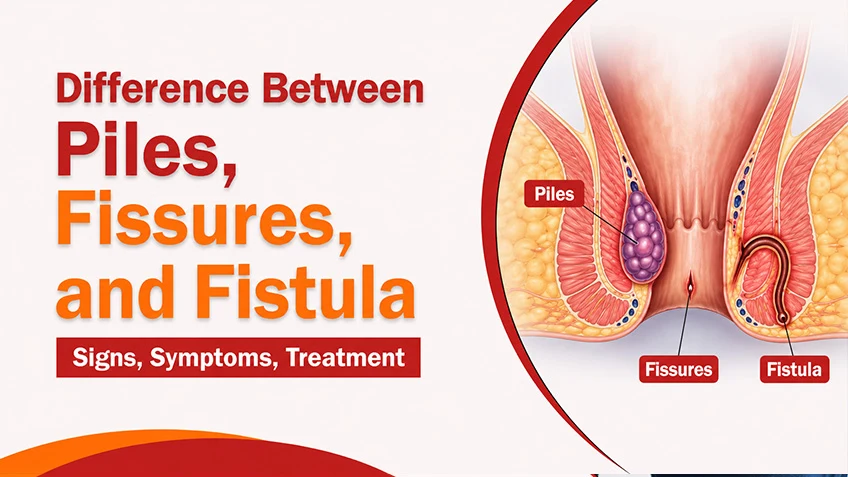
Having pain, blood, or discomfort while passing stools can be very concerning. Often, patients think that it is a case of piles. However, this may not be the case as such symptoms are associated with a fissure or fistula of the anus. These problems have a lot of similarities in terms of the affected area.
Indeed, there are differences between these three diseases. Piles, fissure, and fistula have their own peculiar causes and symptoms and, thus, need special treatment.
This blog post will help you understand the difference between piles and fissures and give a comparison between piles, fissures, and fistulas. We will cover the symptoms, causes and treatment methods and know when to see a doctor.
What Are Piles?
The pile is defined as the enlarged or swollen veins in the lower portion of the rectum or anus. Piles can either be internal (found within the rectum) or external (located around the anus).
Some factors that cause piles are:
- Long-term constipation
- Straining while having bowel movements
- Prolonged sitting on the toilet
- Being pregnant
- Obesity
- Low fiber intake
Some symptoms of piles are:
- Passage of bright red blood during or after defecation
- Itching around the anus
- The presence of a soft bump around the anus
- Pain in mild cases of external piles
- Incomplete emptying of the bowels
In mild cases of piles treatment includes changing diets and medication, while in severe cases, minimally invasive techniques or surgeries are required.
What Is an Anal Fissure?
An anal fissure is basically a tear or cut in the lining of the anal canal. Contrary to piles, a fissure occurs due to damage to the skin surrounding the anus, rather than because of swollen veins.
The following factors can lead to an anal fissure:
- Having hard or big stools
- Constipation
- Frequent diarrhea
- Birth
- Straining too much
The symptoms associated with anal fissure include:
- Severe pain during passing motion
- Burning pain which can last for many hours
- Blood appearing bright red in the stool or on toilet paper
- Visible crack in the anus region
- Spasm of the muscles in the anus area
Among other things, one of the most important aspects of the difference between piles and fissures is the severity of the pain caused by the latter during bowel movement.
What Is an Anal Fistula?
Anal fistula refers to an abnormal passage that exists between the anal canal and the skin surrounding the anus. In most instances, it occurs when there is a failure of healing of an abscess in the anal area, which is usually an infection in the area.
Unlike piles or fissures, a fistula almost always involves an infection.
Symptoms are:
- Pain in the anal area
- Presence of pus discharge
- Inflammation and reddening of the skin
- Formation of boils in the anal area
- Occasional fever
- Pain when sitting or walking
With the distinction between fissure vs fistula, the presence of pus discharge is highly indicative of a fistula and not a fissure.
Piles vs Fissure vs Fistula?
Understanding the fissure and fistula is important because a fistula rarely heals without surgery, while many fissures can improve with conservative treatment.
How Are These Conditions Diagnosed?
Although the symptoms might be similar, these conditions can usually be differentiated by an expert colorectal surgeon by conducting a physical examination.
Diagnosis is done by:
- A detailed patient’s medical history
- Anal physical exam
- Digital rectal examination (if necessary)
- Anoscopy/ proctoscopy
- MRI or endoanal ultrasound (for complicated cases)
Self-diagnosis is not advised since rectal bleeding and pain can be symptoms of some more severe conditions, such as colon disease.
Treatment Options for Piles, Fissures, and Fistula
The kind of treatment that will be used is based on the actual diagnosis and the severity of the condition.
Piles Treatment
For mild cases of piles, the following treatments can work well:
- High fiber diet
- More water consumption
- Stool softeners
- Medications
- Sitz bath
Severe conditions may need:
- Rubber band ligation
- Laser hemorrhoid therapy
- Surgical procedure
Fissure Treatment
An acute fissure usually responds to:
- Diet with lots of fiber
- Good hydration
- Softening the stools
- Sitz baths with warm water
- Medicines for relaxing the anal sphincter muscles
In case of chronic fissures that don’t respond to these treatments, a small surgery can be needed.
Fistula Treatment
In contrast to piles and fissures, a fistula does not self-heal.
Fistula treatment options include:
- Fistulotomy
- Seton insertion
- Laser surgery for fistula
- And other types of minimal surgery
The best treatment option would depend on the fistula location and the severity of the condition.
Can These Conditions Be Prevented?
Although not all of them can be prevented, proper bowel behavior is highly effective in minimizing the risks.
Some ways of prevention are as follows:
- Consume a high-fiber diet that includes a lot of fruit, vegetables, and whole grains.
- Make sure you consume enough water daily.
- Never hold back your stools.
- Don’t push yourself hard to defecate.
- Exercise regularly.
- Maintain a healthy body weight.
- Follow proper anal hygiene practices.
- Get timely treatment for constipation or diarrhea.
These basic steps can help you avoid the formation of piles, fissures, and some types of fistula.
How to Get Rid of Piles, Fissures, and Fistulas
The treatment for these conditions depends on the exact diagnosis and severity. While some cases improve with lifestyle changes and medicines, others may require minimally invasive procedures or surgery.If you're looking for ways to get rid of piles, anal fissures, and anul fistuals, the right treatment depends on the severity of the condition.
For Piles:
- Increase your intake of fiber-rich foods.
- Drink plenty of water to prevent constipation.
- Avoid straining during bowel movements.
- Use prescribed medications or stool softeners.
- Take warm sitz baths to reduce pain and swelling.
- Laser treatment or surgery may be recommended for advanced piles.
For Anal Fissures:
- Follow a high-fiber diet and stay well hydrated.
- Use stool softeners if advised by your doctor.
- Take warm sitz baths to relieve pain and muscle spasms.
- Apply prescribed medicated creams or ointments.
- Chronic fissures that do not heal may require a minor surgical procedure.
For Anal Fistulas:
- Antibiotics alone cannot cure a fistula.
- Surgical treatment is usually required to remove the infected tract.
- Depending on the condition, treatment may include fistulotomy, seton placement, or laser fistula surgery.
- Early treatment helps prevent recurrent infections and complications
When Should You See a Doctor?
Seek medical help in case of:
- Bleeding from the rectum
- Severe pain while defecating
- Itching or swelling that persists
- A lump around the anus
- Discharge of pus or foul-smelling secretion
- Fever accompanied by pain in the anus
- Symptoms that persist for many days
- Recurring anal infections
Early detection enables early treatment to prevent any complications.
Conclusion
Though the diseases of piles, fissures, and fistulas are common ailments in one particular area of the body, they are distinct from each other and have different methods of treatment.
Distinguishing the difference between piles and fissures, as well as the difference between fissure and fistula, will give you an insight into seeking proper medical treatment without delay. Neglecting the symptoms of constant pain, bleeding, or the discharge of pus is dangerous and can cause problems.
If you are suffering from any of the symptoms of piles, fissure, or fistula, please visit the expert surgeons of SCI International Hospital for general surgery in delhi.
Frequently Asked Questions about Piles, Fistula & Fissure
1. Can piles change into a fistula?
No. A fistula cannot form from piles. Generally, a fistula forms when an infected anal gland forms an abscess and then fails to heal.
2. Do all painful bowel movements happen because of a fissure?
No. Painful bowel movements may result from thrombosed external piles and/or anal infections and other anorectal conditions. A differential diagnosis will help diagnose the condition.
3. What is more painful—piles, a fissure, or a fistula?
Piles usually don’t hurt. However, a prolapsing thrombosed pile will hurt. A fissure is more painful. A fistula also causes pain and swelling but this pain is usually more chronic and continuous.
4. Is it possible to treat all three of them with lasers?
Yes. Laser techniques can be used for select cases of piles, chronic fissures, and fistulas. Even so, the type and degree of the condition need to be assessed by a colorectal surgeon to see if the condition can be treated with lasers.
5. How long is the healing period once treated?
Healing times will vary based on the condition and the treatment. Many of the laser and minimally invasive methods allow a return to regular activities within a few days but the condition may still require a few additional weeks to heal completely.