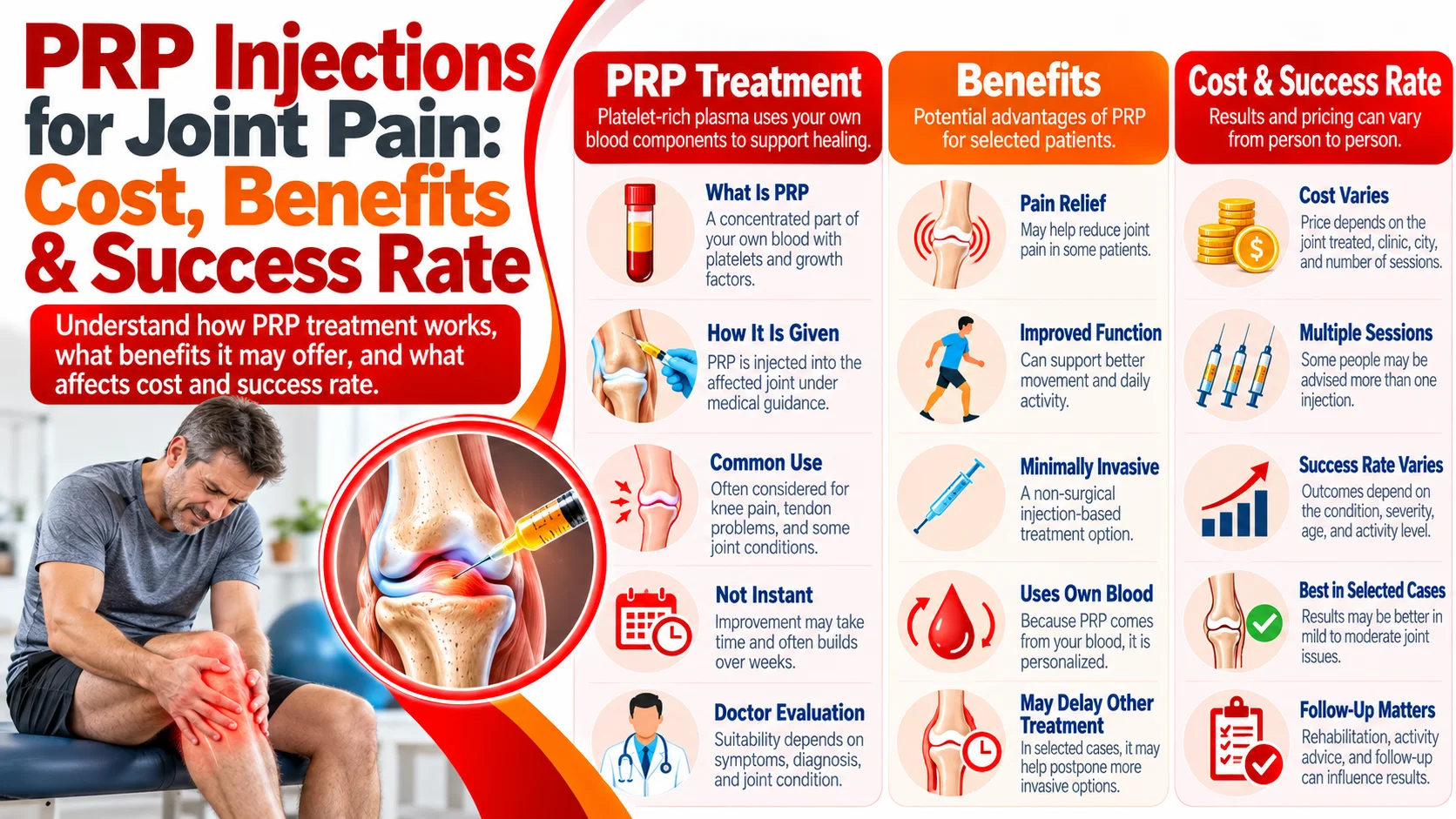
Joint pain can make everyday activities such as walking, climbing stairs, exercising, or playing sports difficult. Depending on the underlying cause, treatment may include medicines, physiotherapy, lifestyle changes, injections, or surgery.
One treatment option that some patients may be offered is PRP injection therapy.
PRP stands for Platelet-Rich Plasma. It is prepared using a patient's own blood and contains a higher concentration of platelets than normal blood. PRP has been studied for several musculoskeletal conditions, particularly knee osteoarthritis and certain tendon problems.
However, PRP does not work equally well for every condition or every patient. Research findings vary depending on the condition being treated, the PRP preparation, injection technique, and other factors.
This guide explains what PRP injections are, how the procedure works, potential benefits and risks, cost factors, recovery, and what patients should know about PRP success rates.
What Are PRP Injections for Joint Pain?
PRP injections use a small sample of the patient's own blood.
The blood is processed to concentrate platelets in the plasma. This platelet-rich plasma is then injected into the affected joint or surrounding tissue, depending on the condition being treated.
Platelets contain substances involved in tissue repair and inflammation. Researchers have therefore studied PRP as a way of potentially reducing pain and improving function in certain musculoskeletal conditions.
However, PRP should not be considered a guaranteed cure for joint pain.
The potential benefit depends on factors such as:
-
The underlying diagnosis
-
Severity of the condition
-
Joint or tissue being treated
-
Age and general health
-
PRP preparation and concentration
-
Injection technique
-
Rehabilitation after treatment
A proper diagnosis is important before deciding whether PRP is appropriate.
How Does PRP Help With Joint Pain?
PRP contains a concentrated number of platelets and other biological components that may influence inflammation and tissue-repair processes.
The strongest body of research has focused on knee osteoarthritis, although PRP has also been investigated for certain tendon and soft-tissue conditions.
Research findings are mixed. Some studies have reported improvements in pain and physical function, while others have found smaller or less consistent benefits.
Differences in PRP preparation, treatment protocols, patient selection, and study design can contribute to differences in outcomes.
For this reason, PRP should be considered as one possible treatment option, rather than a universal treatment for every type of joint pain.
Who May Benefit From PRP Injections?
PRP may be considered for selected patients with conditions such as:
-
Mild to moderate knee osteoarthritis
-
Certain tendon-related conditions
-
Selected sports-related soft-tissue injuries
-
Some chronic musculoskeletal pain conditions
Whether PRP is appropriate depends on the diagnosis and the severity of the condition.
For example, a patient with mild to moderate knee osteoarthritis may have different treatment options from someone with advanced joint damage.
An orthopaedic specialist can evaluate your symptoms, physical examination and imaging findings before discussing whether PRP may be appropriate.
SCI Hospital's orthopaedic department provides evaluation and treatment for joint pain, sports injuries, ligament injuries and other musculoskeletal conditions, with treatment selected according to the underlying diagnosis and the patient's mobility goals.
What Is the Success Rate of PRP Injections?
There is no single success rate for PRP injections that applies to every patient or every joint condition.
Some clinical studies, particularly those involving knee osteoarthritis, have reported improvements in pain and function following PRP treatment. However, other studies have shown limited or inconsistent benefits.
The outcome may depend on:
-
Type and severity of the condition
-
Age and overall health
-
Degree of joint damage
-
PRP preparation
-
Number of injections
-
Injection technique
-
Rehabilitation and activity after treatment
-
Individual response to treatment
Therefore, patients should be cautious about clinics or advertisements that promise a specific PRP success rate.
PRP may help reduce symptoms in selected patients, but it cannot be expected to restore severely damaged cartilage or reverse advanced joint degeneration.
What Is the Cost of PRP Treatment for Joint Pain?
The cost of PRP injections can vary considerably because treatment is individualised.
Factors that may affect the total cost include:
-
Number of injections or sessions required
-
Joint or body area being treated
-
Type of PRP preparation
-
Doctor's consultation and procedure charges
-
Imaging or diagnostic tests, when required
-
Facility charges
-
Follow-up consultations
-
Rehabilitation or physiotherapy requirements
Because these factors vary, there is no single PRP treatment cost that applies to every patient.
Before treatment, ask your healthcare provider about the expected number of sessions, procedure charges, follow-up requirements, and the overall estimated cost.
More importantly, the decision to undergo PRP should be based on whether it is appropriate for your specific diagnosis—not simply on the availability or cost of the injection.
What Happens During a PRP Injection Procedure?
A typical PRP procedure may involve the following steps:
1. Blood Collection
A small amount of blood is collected from the patient.
2. Blood Processing
The blood sample is processed, commonly using a centrifuge, to separate and concentrate the platelets in the plasma.
3. Treatment Area Preparation
The skin over the treatment area is cleaned and prepared for the injection.
4. PRP Injection
The prepared platelet-rich plasma is injected into the targeted joint or tissue.
The exact injection technique can vary depending on the joint, condition and treatment approach.
5. Aftercare
Your doctor may provide instructions regarding physical activity, medicines, exercise, and follow-up after the injection.
In some situations, imaging guidance may be used to help accurately target the treatment area.
How Long Does PRP Take to Work?
PRP does not usually provide instant pain relief.
Some patients may experience temporary soreness or increased discomfort shortly after the injection. Improvement, when it occurs, may develop gradually over the following weeks.
The time required to notice improvement varies according to:
-
The condition being treated
-
Severity of the problem
-
Individual healing response
-
Rehabilitation
-
Activity level after treatment
Following your doctor's post-treatment instructions can help support recovery.
If pain becomes severe, persistent, or is accompanied by significant swelling, fever, redness, or other concerning symptoms, contact your healthcare provider.
Are PRP Injections Safe?
Because PRP is prepared from the patient's own blood, allergic reactions to the injected material are generally less of a concern than with some other injectable substances.
However, PRP is still an injection procedure and can have potential side effects.
Temporary effects may include:
-
Pain or soreness at the injection site
-
Swelling
-
Bruising
-
Temporary increase in discomfort
As with any injection, there is also a small risk of infection or other complications.
Before PRP treatment, tell your doctor about your medical conditions and all medicines or supplements you take.
Your doctor can explain whether PRP is appropriate for you and discuss the potential benefits and risks.
Is PRP Better Than Physiotherapy or Other Treatments?
PRP is not automatically better than other treatment options.
The appropriate treatment depends on the underlying cause of joint pain.
Depending on the diagnosis, treatment may include:
-
Physiotherapy
-
Exercise and strengthening
-
Activity modification
-
Medicines
-
Weight management when appropriate
-
Injections
-
Arthroscopy
-
Joint-preserving procedures
-
Joint replacement surgery
For example, SCI Hospital's orthopaedic department provides both non-surgical and surgical treatment options for joint and musculoskeletal conditions, including arthroscopy, ligament reconstruction and joint replacement when clinically appropriate.
When Should You Consider Seeing an Orthopaedic Specialist?
You should consider an orthopaedic evaluation if joint pain:
-
Persists for several weeks
-
Interferes with walking or exercise
-
Makes it difficult to climb stairs
-
Causes significant stiffness
-
Limits daily activities
-
Keeps returning despite home treatment
-
Is associated with swelling or reduced joint movement
An orthopaedic specialist can determine the underlying cause and discuss whether physiotherapy, medication, injections such as PRP, or another treatment is appropriate.
Why Is Diagnosis Important Before PRP Treatment?
Joint pain can have many different causes.
Knee pain, for example, may be associated with osteoarthritis, ligament injury, meniscus problems, tendon conditions, inflammatory disorders, trauma, or other causes.
Because treatment depends on the diagnosis, PRP should not be considered simply because a patient has "joint pain."
A proper evaluation may include:
-
Medical history
-
Physical examination
-
Assessment of joint movement
-
Evaluation of strength and stability
-
X-ray or other imaging when required
-
MRI or additional investigations in selected cases
Once the underlying problem is identified, your orthopaedic specialist can discuss the available treatment options.
PRP for Knee Osteoarthritis
Knee osteoarthritis is one of the conditions for which PRP has been studied most extensively.
Some patients with mild to moderate knee osteoarthritis may experience improvement in pain and function after PRP treatment.
However, PRP is not appropriate for every patient with knee arthritis.
Patients with advanced joint damage may require a different treatment approach depending on symptoms, imaging findings, mobility limitations and overall health.
SCI Hospital provides comprehensive orthopaedic care for knee and joint conditions, including non-surgical management, arthroscopy and knee replacement procedures when clinically indicated.
Can PRP Replace Knee Replacement Surgery?
Not necessarily. PRP should not be viewed as a replacement for knee replacement surgery in every patient. If knee osteoarthritis has progressed to severe joint damage and significantly affects mobility and quality of life, an orthopaedic specialist may discuss other treatment options, including joint replacement.
SCI Hospital provides total knee replacement surgery in Delhi for patients whose knee condition requires joint replacement after appropriate evaluation.
The appropriate treatment depends on the severity of joint damage and the patient's symptoms and functional goals.
What Should You Ask Before Getting PRP?
Before undergoing PRP treatment, consider asking your doctor:
-
What is causing my joint pain?
-
Is PRP appropriate for my diagnosis?
-
What evidence supports PRP for my condition?
-
How many injections might I need?
-
When should I expect improvement?
-
What side effects should I watch for?
-
What activities should I avoid after treatment?
-
Will I need physiotherapy?
-
What is the estimated total treatment cost?
-
What other treatment options are available?
These questions can help you make an informed decision about your treatment.
Conclusion
PRP injections may be a treatment option for selected patients with certain joint, tendon, and musculoskeletal conditions. Research, particularly in knee osteoarthritis, has shown potential benefits for some patients, but results are not consistent for everyone.
There is no universal PRP success rate or fixed treatment cost. Outcomes and costs can vary according to the diagnosis, severity of the condition, PRP preparation, number of sessions, treatment area, and individual response.
PRP should therefore be considered only after an appropriate medical evaluation.
At SCI International Hospital, a multispeciality hospital in Delhi, patients can receive comprehensive orthopedic care in Delhi for joint pain, sports injuries, ligament problems and other musculoskeletal conditions. Treatment is planned according to the underlying diagnosis and may include physiotherapy, medicines, injections, arthroscopy, joint-preserving procedures or joint replacement when clinically appropriate.
If you have persistent joint pain, an orthopaedic specialist can help identify the cause and discuss which treatment options may be appropriate for you.
Frequently Asked Questions About PRP Injections for Joint Pain
What is the average success rate of PRP injections for knee pain?
There is no single success rate that applies to every patient. Research on PRP for knee osteoarthritis has reported varying outcomes, with some patients experiencing improvement in pain and function while others experience limited or temporary benefit.
How many PRP injections are needed for knee pain?
The number of injections depends on the diagnosis, treatment protocol and individual response. Some treatment plans may involve a single injection, while others may involve multiple sessions.
How long does PRP take to work?
PRP does not usually provide immediate pain relief. Some patients may notice improvement over the following weeks, but the response and timeline vary according to the condition and individual healing response.
What are the side effects of PRP injections?
Temporary soreness, pain, swelling or bruising at the injection site may occur. As with other injections, there is also a small risk of infection or other complications.
Is PRP good for knee osteoarthritis?
PRP may benefit some patients with knee osteoarthritis, particularly selected patients with mild to moderate disease. However, results vary and PRP is not appropriate for every patient.
Can PRP rebuild damaged cartilage?
PRP should not be presented as a treatment that reliably restores severely damaged cartilage. Its potential role is mainly related to symptom improvement and functional outcomes in selected conditions.
Can PRP replace knee replacement surgery?
Not in every case. Patients with advanced knee joint damage may require other treatments, including knee replacement, depending on their symptoms, imaging findings and functional limitations.
Is PRP treatment painful?
The injection may cause temporary discomfort or soreness. Your doctor can explain what to expect during and after the procedure and how to manage post-injection discomfort.
How much does PRP treatment cost?
PRP cost varies depending on the treatment area, number of sessions, PRP preparation, consultation, imaging, facility charges and other factors. An exact cost can be discussed after an appropriate medical evaluation.
Who should I consult before getting a PRP injection?
An orthopaedic specialist can evaluate the cause of your joint pain and determine whether PRP or another treatment option is appropriate for your condition