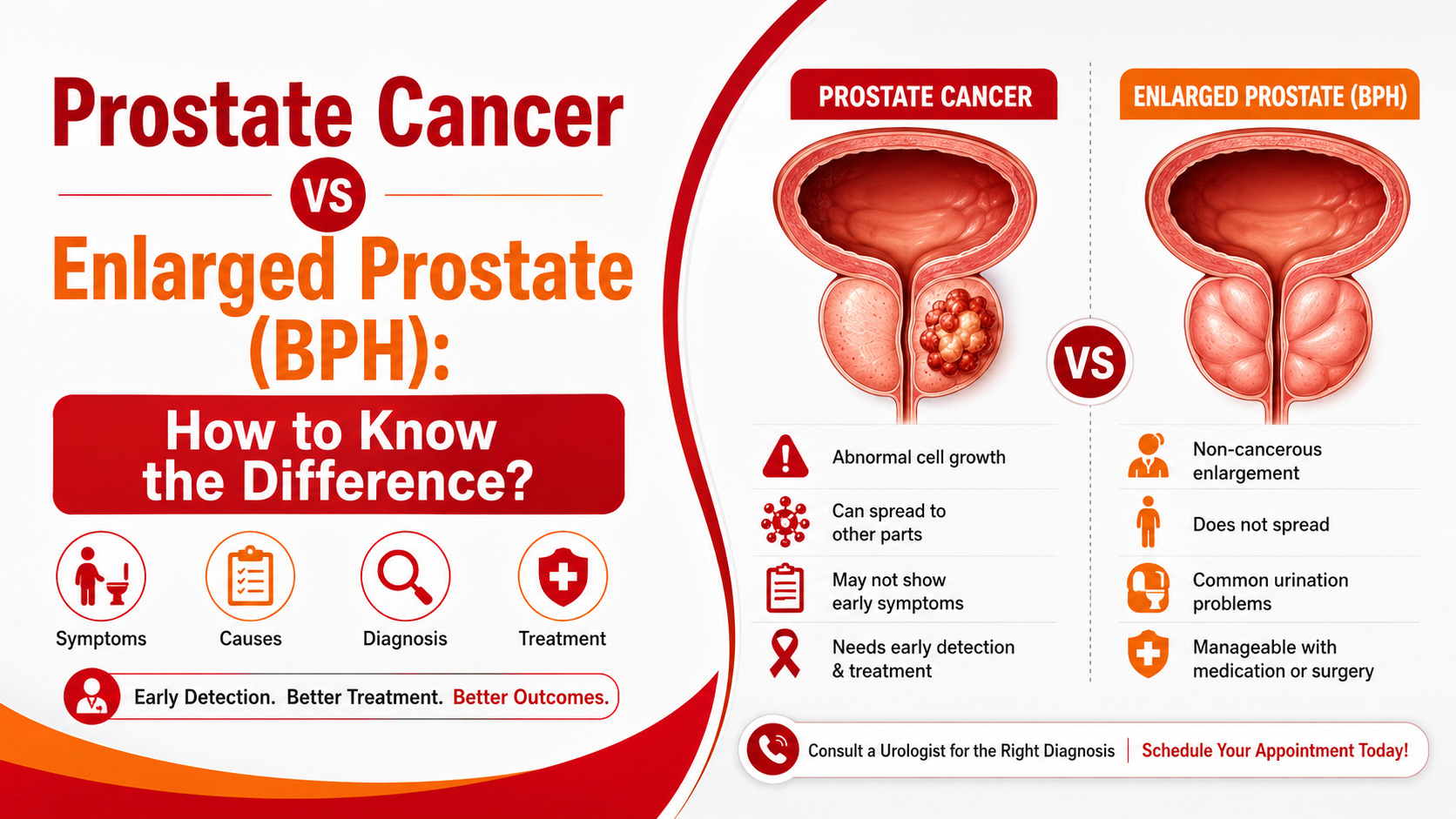
A weak urine stream that is waking several times in the night, or having trouble beginning to urinate, may cause a man to be concerned about prostate cancer. However, these signs are typical of benign prostatic hyperplasia (BPH) or an increased prostate. Both conditions have the same gland; however, they're not the same illness. BPH is not cancerous, whereas prostate cancer is caused by abnormal cancer cells. The tricky part is that the symptoms of both conditions can overlap, particularly during the initial stages.
Key Differences in Symptoms
The simplest difference is what is causing the prostate to grow.
In BPH, the prostate becomes larger because the number of normal prostate cells increases. As the gland grows, it can press on the urethra and make it harder for urine to pass. BPH is common as men get older and does not increase the risk of developing prostate cancer. More details about the condition are covered in SCI Hospital's enlarged prostate (BPH) information.
Prostate cancer is different. It starts when abnormal cells in the prostate grow in an uncontrolled way. Some prostate cancers grow slowly, while others can be more aggressive and spread beyond the prostate.
One important point is that having BPH does not mean that a man will develop prostate cancer later. However, both conditions can exist in the same person, which is why urinary symptoms should not automatically be blamed on an enlarged prostate.
What Symptoms Are Common in BPH?
BPH most commonly affects the urination process because the enlarged prostate that is larger can narrow the urinary tract.
Common symptoms are:
- The difficulty of starting urine
- The flow of urine is slow or weak.
- Urine flow stops and then begins
- Frequent urination
- Awakening several times during the night to go to the bathroom
- An overwhelming or sudden desire to urinate
- The dribbling occurs at the end of urination
- The feeling that the bladder isn't completely empty
Prostate size may not always correspond to the degree of the symptoms. A man who has an increased prostate size might have significant urinary issues; however, a man with a bigger prostate might be suffering from minor symptoms.
If BPH is serious, it could result in urinary retention, recurrent urinary infection, and kidney stones. issues). This link has been removed as the TURP webpage is a principal page, and linking the whole list of complications to it was much more extensive than the content for the destination.
What Symptoms Can Prostate Cancer Cause?
The early stages of prostate cancer usually have no symptoms. This is the reason why it is not easy to diagnose by looking up whether a person suffers from difficulty urinating.
If symptoms do occur, they could include trouble getting started or a weak stream and frequent urination, or difficulty emptying the bladder. They can also be seen in BPH.
More concerning symptoms can include blood in the urine or semen and persistent pain in the back, hips, or pelvis, particularly when prostate cancer has become more advanced. But these symptoms do not prove that cancer is present either. Other conditions can cause them as well.
This overlap is why symptoms alone cannot reliably tell BPH and prostate cancer apart.
Can a PSA Test Tell the Difference?
PSA, or prostate-specific antigen, is one of the tests that doctors can employ when looking for prostate issues. However, a high PSA doesn't necessarily mean prostate cancer.
PSA may rise due to prostate cancer; however, it also increases due to BPH or prostatitis, as well as other prostate-related ailments. The single PSA result has to be considered in conjunction with the man's age, his symptoms on examination, and other results.
This is an important point for those who have an unexpectedly high PSA result: don't believe that you are diagnosed with cancer just based on PSA only.
How Do Doctors Find Out Whether It Is BPH or Prostate Cancer?
The examination usually begins with your symptoms and medical background. Urologists may recommend an array of tests.
Digital Rectal Examination
In a digital rectal exam (DRE), the doctor will feel the prostate via the rectum. It is able to provide details about the prostate's size as well as whether areas appear to be abnormal.
PSA Blood Test
A PSA test determines the amount of prostate-specific antigen present in the blood. It could be used to support the assessment; however, it does not, on its own, eliminate prostate cancer.
Urine and Other Tests
The urine test can be performed to determine if there is an infection or blood. Based on the signs, the doctor can also test the flow of urine as well as the amount of urine that remains in the bladder following urination, or the size of the prostate.
MRI and Prostate Biopsy
If the findings cause concern regarding prostate cancer, an MRI can help pinpoint areas that require further investigation. If cancer is to be identified, a prostate biopsy can be utilized to test prostate tissue for cancerous cells. The doctor. Kartik Sharma's SCI Hospital profile identifies the TRUS-guided prostate biopsy as one of his services.
Therefore, there isn't a single home-based symptom, PSA number, or examination that will always reveal whether you're suffering from BPH or cancer of the prostate.
Does BPH Turn Into Prostate Cancer?
No. BPH does not turn into prostate cancer.
They are separate conditions. BPH is a non-cancerous growth of prostate tissue, while prostate cancer develops from abnormal cancer cells. However, a man can have BPH and prostate cancer at the same time.
That is why persistent or new prostate symptoms should still be evaluated rather than simply being labelled as “normal with age.”
How Are BPH and Prostate Cancer Treated?
It all depends on the results from the assessment.
With BPH, for example, mild cases can be treated with watchful waiting, behavioral modification, or medication. In cases where there is significant distress or the use of medication does not work, TURP or laser prostate surgery can be recommended. The SCI Hospital also offers treatment options for prostate enlargement (BPH) through medicine or surgery.
In the case of prostate cancer, treatment will depend on a number of things like the type of cancer, its stage, aggressiveness, and the health status of the patient. Treatment options may involve active surveillance, surgery, radiation, or medication.
When Should You See a Urologist?
Do not wait for symptoms to become severe before getting checked. A urologist should evaluate symptoms such as:
- Repeatedly waking up at night to urinate
- Difficulty starting or maintaining urine flow
- Weak or interrupted urine stream
- Blood in the urine or semen
- Persistent pain in the back, hips, or pelvis
- Difficulty emptying the bladder
- A raised or changing PSA result
- A family history of prostate cancer
A particularly important warning sign is being unable to pass urine at all. This can indicate acute urinary retention and needs prompt medical attention.
Prostate Evaluation at SCI International Hospital
At SCI International, a multispecialist hospital, prostate problems can be evaluated with appropriate tests to distinguish conditions such as BPH from other prostate disorders. Dr. Kartik Sharma, Urologist, has specific expertise in Uro-Oncology, TRUS-guided prostate biopsy, and robot-assisted radical prostatectomy, which is relevant for patients who need evaluation for suspected prostate cancer.
SCI Hospital also provides urology care for prostate enlargement and other urinary conditions.
Conclusion
BPH as well as prostate cancer can be two distinct prostate cancers, even though certain symptoms may be alike. BPH is not cancerous and mostly causes urinary problems due to the prostate being enlarged, which can press against the urinary tract. Prostate cancer can not present symptoms until its infancy and is not diagnosed based on urinary symptoms or the PSA result on its own. If you are experiencing persistent urinary symptoms or have concerns regarding your PSA, a thorough urine test can identify the source and recommend the best treatment.
FAQs
Does an enlarged prostate mean something similar to prostate cancer?
No. Prostate cancer, also known as BPH, is a non-cancerous disease. Prostate cancer is a form of cancer that has abnormal cells that are growing in the prostate.
Can BPH turn into prostate cancer?
No. BPH is not a precursor to prostate cancer. But both conditions could be present in the same person.
Could BPH or prostate cancer share similar signs?
Yes. Both can result in urinary symptoms like weak urine flow, difficulty getting started, and frequent urine leaks. The symptoms alone are not able to distinguish between them.
Do high PSA levels always indicate prostate cancer?
No. PSA may be elevated as a result of prostate cancer, BPH, prostatitis, and various prostate ailments. Doctors must interpret the results in conjunction with other results.
Are prostate cancers always associated with urinary tract problems?
No. Prostate cancer that is diagnosed early usually has no symptoms. This is a reason why an appropriate diagnosis is crucial in cases of risks or abnormal results from tests.
Do you need a prostate biopsy to treat BPH?
A biopsy is not typically required just to detect BPH. It is recommended that if the examination raises concerns about prostate cancer, confirmation is required.