Many expectant mothers want to understand the difference between painless delivery and natural birth before preparing their birth plan.
The important point is that these are not necessarily two different types of delivery. Both can result in a vaginal birth. The main difference is how labour pain is managed.
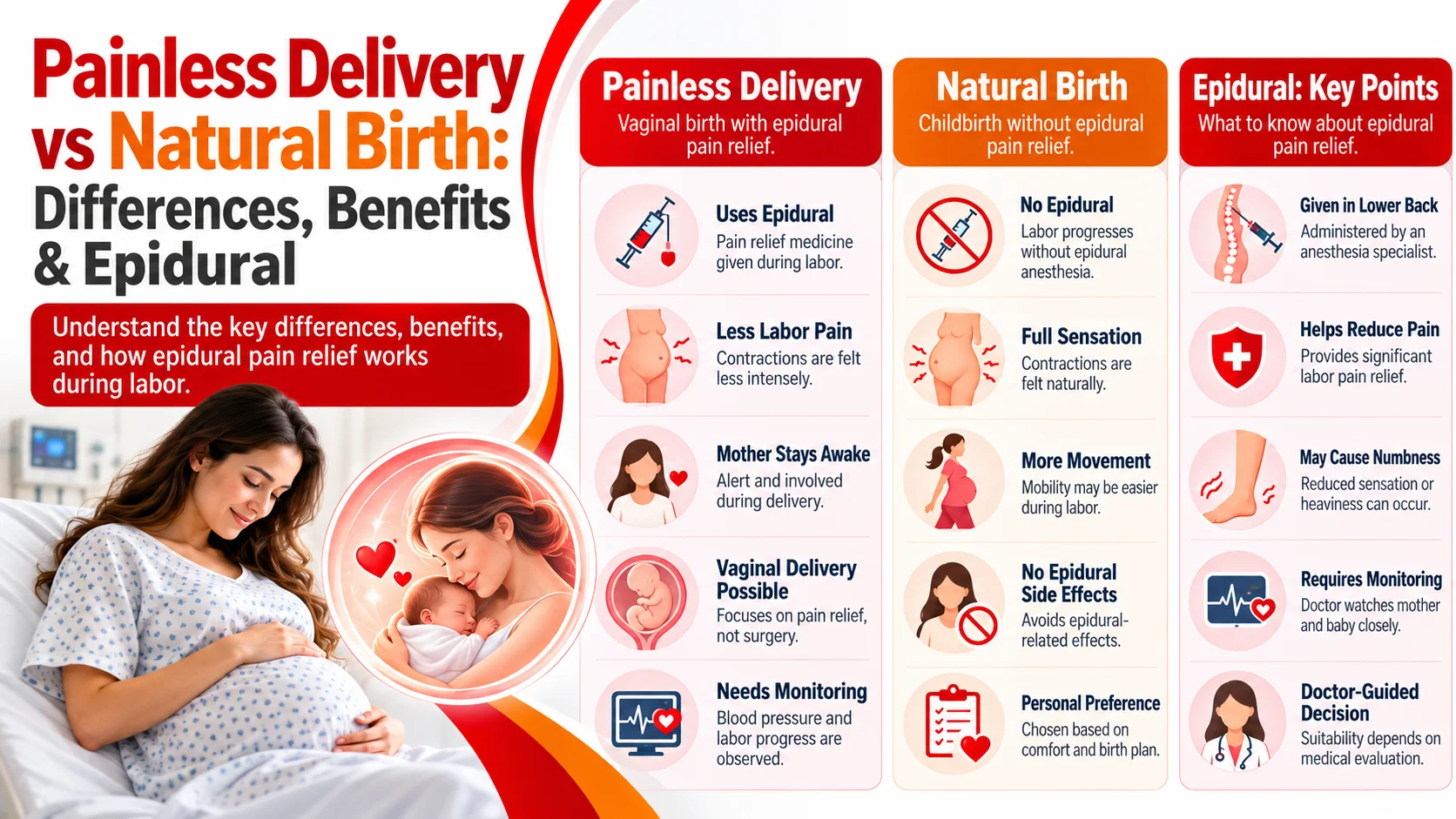
Natural birth generally refers to vaginal birth with little or no medical pain relief, while painless delivery commonly refers to vaginal birth with medical pain relief such as epidural analgesia.
Your choice of pain relief depends on your preferences, pregnancy, health, labour progress, and your obstetrician's advice.
What Is Natural Birth?
Natural birth generally refers to a vaginal delivery with little or no medical pain medication during labour.
A woman may use non-medical methods to manage labour discomfort, such as:
- Breathing and relaxation techniques
- Changing positions
- Walking or moving around when appropriate
- Massage
- Warm showers or baths, where available and suitable
- Support from a birth partner
- Guidance from the maternity team
Some women prefer this approach because they want to minimise medical pain relief or feel comfortable managing contractions with non-medical techniques.
However, choosing natural birth does not mean that you have to manage labour alone. Your maternity team continues to monitor you and your baby throughout labour and can discuss pain-relief options if your needs or preferences change.
What Is Painless Delivery?
Painless delivery is a commonly used term for a vaginal delivery in which medical pain relief is provided during labour. One of the most commonly used options is epidural analgesia. An epidural is administered by an anaesthesia specialist and works by reducing sensation and pain from labour contractions.
You remain awake and can participate in the birth. Although the pain can be significantly reduced, you may still feel:
- Pressure
- Tightening
- Touch or movement
- Sensations during pushing
Therefore, the term "painless delivery" should not be interpreted as a guarantee that you will feel absolutely nothing. A more medically accurate description is vaginal delivery with epidural pain relief.
SCI Hospital's normal delivery service includes painless labour options using epidural analgesia for eligible mothers, with assessment by the obstetric and anaesthesia teams.
Painless Delivery vs. Natural Birth: What's the Difference?
The main difference is pain management
An epidural changes how labour pain is managed. It does not, by itself, change a vaginal delivery into a C-section.
Is Painless Delivery Really Painless?
Not necessarily. An epidural can provide significant relief from labour pain, but the amount of pain relief varies between individuals.
You may still experience pressure, tightening, touch, or sensations associated with contractions and pushing.
This is why "painless delivery" is best understood as labour with reduced pain through medical pain relief, rather than a delivery in which you feel absolutely no sensation.
What Are the Benefits of Natural Birth?
Some women prefer natural birth because they want to minimise medical pain medication during labour.
Potential advantages of this approach may include:
- The ability to move and change positions, depending on your stage of labour and medical monitoring
- Use of breathing and relaxation techniques
- Avoiding medication-related side effects associated with epidural analgesia
- Maintaining a labour experience with little or no pharmacological pain relief
Vaginal birth can also have a generally shorter recovery than a C-section because it does not involve abdominal surgery. However, recovery varies from one woman to another and can be affected by factors such as tears, stitches, assisted delivery, or a prolonged labour.
SCI Hospital's normal delivery care in Delhi includes antenatal monitoring, labour management and postnatal support.
What Are the Benefits of Painless Delivery?
The main benefit of an epidural is effective labour pain relief. For women who experience significant discomfort during contractions, epidural analgesia may make labour more manageable.
It may also help some women remain more relaxed during a long or particularly painful labour. Importantly, having an epidural does not mean that you have chosen a C-section.
If vaginal delivery remains medically appropriate and labour progresses safely, you can have a vaginal birth after receiving an epidural.
Are There Any Downsides or Risks of an Epidural?
An epidural is a medical procedure, so it can have potential side effects and limitations.
Some women may experience temporary effects such as:
- Lower blood pressure
- Heaviness or reduced sensation in the legs
- Difficulty moving around without assistance
- Difficulty passing urine
- Headache in uncommon cases
- Changes in the way pushing feels
The anaesthesia team monitors you and can manage potential side effects when they occur.
An epidural may also not be suitable in certain medical situations. Your obstetrician and anaesthetist will assess your health, medications, pregnancy and other relevant factors before recommending it.
Does an Epidural Increase the Chance of a C-Section?
An epidural is a pain-relief method, not a C-section procedure.
Receiving an epidural does not automatically mean that you will require a Caesarean delivery.
The final mode of delivery depends on factors such as:
- The mother's health
- The baby's condition
- Baby's position
- Progress of labour
- Cervical dilation
- Fetal heart-rate patterns
- Placental or pregnancy-related complications
If a C-section becomes medically necessary, it is decided based on the clinical situation rather than simply because an epidural was used. For a detailed comparison, read Normal Delivery vs C-Section: Benefits, Risks & Recovery
Which Is Better: Painless Delivery or Natural Birth?
There is no single option that is best for every woman. Some women prefer to experience labour with little or no medical pain relief. Others prefer epidural analgesia because they want stronger pain relief during labour.
Your preference may also change. For example, you may initially plan to avoid an epidural but later decide that you would like pain relief. Another woman may plan to have an epidural but decide she does not need it.
Discussing your options during pregnancy can help you understand what is available and what may be suitable for you. The safest approach is to keep your birth preferences flexible while allowing your obstetrician to make recommendations based on your and your baby's condition.
Can You Have a Normal Delivery With an Epidural?
Yes. An epidural is used to manage labour pain. It does not automatically change a vaginal delivery into a Caesarean delivery. If there is no medical reason for a C-section and labour progresses safely, a woman can have a vaginal birth with epidural pain relief.
SCI Hospital's normal delivery service specifically includes painless labour options with epidural analgesia, along with fetal monitoring and anaesthesia support.
How Should You Prepare for Your Delivery?
It is helpful to discuss your birth preferences during your antenatal appointments rather than waiting until labour begins.
You can ask your obstetrician:
- What pain-relief options are available?
- Is an epidural suitable for me?
- When can an epidural be given during labour?
- Will I still be able to push after receiving an epidural?
- How will my baby be monitored during labour?
- What happens if labour does not progress as expected?
- Under what circumstances might a C-section become necessary?
Understanding your options in advance can help you feel more prepared for different possibilities during labour.
SCI Hospital provides maternity care in Delhi, including antenatal care, normal delivery, painless labour options, Caesarean delivery and postnatal care.
Natural Birth vs Painless Delivery: Which Pain-Relief Option Is Right for You?
Your birth plan should be based on your preferences as well as your medical circumstances. Natural birth may appeal to women who prefer little or no medical pain relief, while epidural analgesia may be preferred by women who want stronger pain relief during labour.
There is also no requirement that your initial preference must remain unchanged throughout labour. Your obstetrician can discuss the available options with you and help you understand their potential benefits, limitations and suitability for your pregnancy.
Conclusion
Painless delivery and natural birth can both result in a vaginal delivery. The main difference is how labour pain is managed. Natural birth generally involves little or no medical pain relief, while painless delivery commonly refers to vaginal delivery with pain relief such as an epidural.
An epidural can significantly reduce labour pain while allowing the mother to remain awake and participate in the birth. It does not automatically mean that a C-section will be required.
The most appropriate approach depends on your preferences, health, pregnancy, labour progress and the condition of your baby.
At SCI International Hospital, a multispeciality hospital in Delhi, the maternity team provides antenatal care, normal delivery, painless labour with epidural analgesia, Caesarean delivery and postnatal support.FAQs About Painless Delivery vs. Natural Birth
Is painless delivery the same as normal delivery?
Not exactly. Painless delivery usually refers to a normal vaginal delivery in which medical pain relief, commonly an epidural, is used during labour. Normal delivery can also take place without an epidural.
Does an epidural completely stop labour pain?
An epidural can significantly reduce labour pain, but it may not remove every sensation. You may still feel pressure, tightening, touch or sensations during pushing.
Can I have a normal delivery after taking an epidural?
Yes. An epidural is a method of pain relief and does not automatically require a C-section. If vaginal delivery remains medically appropriate, you can have a vaginal birth after receiving an epidural.
Is natural birth safer than painless delivery?
Neither approach is automatically safer for every woman. The appropriate choice depends on your health, pregnancy, labour and the condition of your baby. Your obstetrician can help you understand which pain-relief options are suitable for you.
Can I decide about an epidural during labour?
In many situations, women can discuss epidural pain relief during labour. However, availability and suitability depend on factors such as your medical condition, stage of labour and the anaesthesia team's assessment. Discussing your options during pregnancy is recommended.
Can an epidural increase the chance of a C-section?
An epidural itself does not mean that you will need a C-section. The decision about the mode of delivery depends on the health of the mother and baby and how labour progresses.
How long does an epidural take to work?
After the epidural is administered, it generally takes some time for the medication to provide its full effect. Your anaesthetist will monitor you and adjust the medication as needed.
Is epidural delivery available at SCI Hospital?
Yes. SCI Hospital's normal delivery service states that painless labour with epidural analgesia is available for eligible mothers, with assessment and support from the obstetric and anaesthesia teams.