When a hernia is deemed to be a surgical need, one of the first things that patients need to know is whether they need an open or laparoscopic hernia repair. Both procedures are utilized to repair hernias; however, how the surgeon gets to the area that is weaker differs.
Laparoscopic surgery is performed using cameras and small cuts. Open surgery involves a larger cut directly across the hernia. Laparoscopic repair usually results in less discomfort and a faster return to regular activities; however, it's not the best option for everyone. The kind of hernia it is located in, the size prior to surgery, as well as your overall health, are all factors.
Hoto w Is Open Hernia Surgery Done?
In the case of open hernia repair, the surgeon makes an incision across the hernia. The tissue that has been pushed through the weak region is repositioned, and the muscle that is weak is then repaired. A mesh is placed to help strengthen the area and reduce the chances of the hernia returning.
The surgeon can view the hernia from a distance, which can be very useful in complicated or large cases.
The open surgery procedure has been utilized for several years and is a popular method of repairing hernias. With the hernia's location and the health of the patient, it could be possible to make use of regional or local anaesthesia, rather than general anaesthesia.
What Happens During Laparoscopic Hernia Surgery?
Laparoscopic hernia repair can be known as keyhole surgery. Instead of a single, bigger cut, the surgeon will make tiny incisions and then insert a camera and small instruments through the incisions.
The surgeon makes use of the camera to view the problem area from inside and then repairs it, typically using mesh.
Lesser cuts result in less harm to the tissue around them. Patients often experience less pain and fewer marks afterward. Another benefit is that if there are hernias on both sides, they are often repaired in the same procedure.
However, laparoscopic surgery is a procedure that requires general anaesthesia and is not appropriate for all hernias.
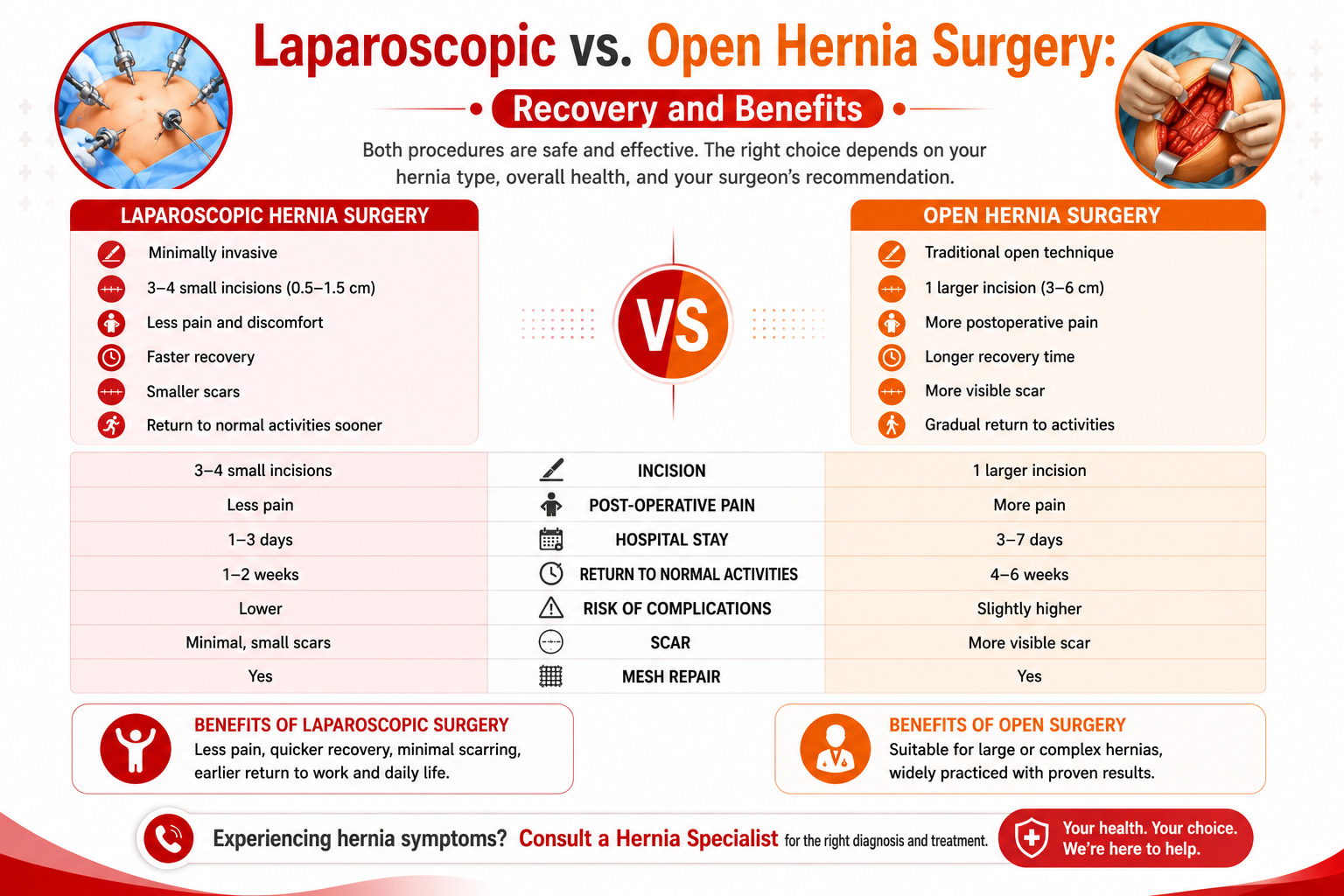
Laparoscopic vs. Open Hernia Surgery: What Is the Difference?
These are general differences. The best approach depends on the particular hernia rather than one method being better in every situation.
What Are the Benefits of Laparoscopic Hernia Surgery?
The main benefit lies in the fact that cuts aren't too big.
Since there is less disruption in the tissues, patients experience less pain, fewer marks, and a faster return to regular routines. This is particularly beneficial for those who wish to resume routine activities or work earlier.
Laparoscopic repair is beneficial when there are hernias or hernias on both sides. The surgeon can reach both sides without needing to make one large incision for each.
There are some limitations, however. The procedure generally will require general anaesthesia. It may not be the best procedure for complex, large, or frequent hernias.
What Are the Benefits of Open Hernia Surgery?
Surgery that is open provides the surgeon with entry into the. This is beneficial when the hernia is very large and has a complex location or requires an easier repair.
It could also be a consideration for patients who might not be able to undergo general anaesthesia.
Another thing to remember to consider is the fact that size of cut doesn't determine whether or not the surgery will be effective. An open repair that is well planned is a viable option for the patient who is in the right position.
The decision is based on which method will provide the safest and most appropriate fix for the particular hernia.
Which Surgery Has a Faster Recovery?
In general, the recovery following laparoscopic repairs is typically faster.
A lot of people can resume normal daily activities within a few weeks, but this can vary according to the kind of hernia they suffer as well as the kind of work they are doing and how well their body recovers. The weight of heavy lifting and intense exercise are generally kept to a minimum for a period of time.
The procedure may take longer time, particularly if the procedure involves a large or complicated hernia. It could also cause discomfort around the area of the incision for the initial few days.
It's not solely about counting down days. Swelling, pain, the dimension of your hernia as well as your overall health are all factors that contribute to.
Does Laparoscopic Surgery Hurt Less?
Often, yes, especially during the early recovery period.
The smaller cuts in laparoscopic surgery mean pain around the surgical site is typically less. In fact, people often experience shoulder and/or abdominal discomfort post-surgery, as gas is used during the surgery to expand the abdominal cavity.
Completely the opposite, open surgery means more pain from the larger healing incision, as moving (coughing, bending) is more uncomfortable while recovering.
In the end, neither surgery will be quite painless, but it will be less painful in laparoscopic surgery, even if the discomfort is longer
When May Open Surgery Be a Better Choice?
Open repair may be considered when the hernia is very large or complicated, or when the surgeon needs direct access to the area.
It may also be useful in certain recurrent hernias or in patients who are not suitable for general anaesthesia.
The type of hernia matters as well. Inguinal, femoral, umbilical, and incisional hernias are not all repaired in exactly the same way. For example, femoral and inguinal hernias occur in different parts of the groin, and their risks and treatments can differ.
When May Laparoscopic Surgery Be Preferred?
Laparoscopic repair is a possibility in cases where the hernia is appropriate for a minimally-invasive procedure and the patient is able to undergo general anaesthesia. It's particularly helpful in the case of bilateral hernias and also for recurrent hernias following an open repair.
The choice is made when taking a look at the hernia, and not based on the fact that laparoscopic surgery leaves smaller scars.
Can a Hernia Come Back After Surgery?
There is always the possibility of recurrence following hernia repair.
The likelihood of getting it depends on a variety of aspects, such as the nature and the dimensions of hernia, procedure for repair and the health of the patient, as well as how quickly the wound heals.
Following the advice given to you for recovery is equally important. Your doctor may advise that you avoid lifting for a certain period of time. for a time frame and gradually return to exercising instead of performing too much too soon.
So, Which Hernia Surgery Is Better?
There is no single answer.
For certain patients, laparoscopic surgery can offer the advantages of a smaller cut and faster recovery. For others, specifically with a complicated or large hernia, an open repair might be the best option.
The surgeon will take into consideration the size, type and position of the hernia, if you've been through surgery before or not, your general health condition, and the type of anaesthesia which is appropriate for you.
Therefore, the more important question isn't "Which surgery is best?" but rather "Which repair is safest and most suitable for my hernia?"
When Should You Get a Hernia Checked?
Hernias can appear as a bulge or lump in the abdomen or groin. It is more obvious when you cough, stand, strain, or move something.
It is important to get it examined when the lump becomes more painful or begins to affect normal activities.
See a doctor immediately when your lump becomes difficult, painful, or hard to remove, especially if you experience vomiting, severe abdominal pain that is severe, or difficulty in passing stool. This could indicate an infected or strangulated hernia.
Conclusion
Laparoscopic and open hernia surgery can both be effective ways to repair a hernia. Laparoscopic surgery usually offers smaller cuts, less early pain, and a quicker recovery, while open surgery can be a better choice for some large, complex, or recurrent hernias. The right approach depends on the hernia and the patient's overall health, not simply on which technique is newer. At SCI International Hospital, a multispecialist hospital, Dr. Nabanita Chatterjee, a general surgeon with 30 years of experience, provides laparoscopic hernia repair and other general surgical treatments.
FAQs
Q- How does laparoscopic hernia surgery compare to an open approach?
Ans- Laparoscopic hernia repair has become the gold standard over open hernia repair surgery, but there is still a time/place for both procedures. Open hernia repairs are often employed for larger and/or more complicated hernias. Recovery from laparoscopic hernia surgery is unparalleled, and when paired with the lower rate of complications and smaller, less noticeable scars, become an easy sell for most patients.
Q- What is the recovery like for laparoscopic hernia surgery?
Ans- They can become more specific, but even in the context of laparoscopic hernia surgery, recovery times will vary based on the subtype of hernia, the repairs performed, and the health of the patient.
Q- What is post-operative pain like after hernia surgery?
Ans- Pain will likely be greater in the days following surgery due to the larger incisions and will be more noticeable in the days following the surgery. However, pain is highly subjective, so patients may experience very different phenomena.
Q- Can you avoid surgery for a hernia?
Ans- Hernias will not correct themselves. Hernias that are small and completely asymptomatic may be a good candidate for surveillance; however, the repair of a hernia is the only way to rectify a hernia defect.
Q- How long is the recovery time for hernia surgery?
Ans- The great majority of patients can return to an unrestricted daily routine just 1-2 weeks after surgery, especially if laparoscopic surgery was performed. However, heavy lifting or engaging in strenuous activity will still be restricted for a period of time, usually at least 6 weeks.