Abdominal pain after lifting something heavy, exercising, or making a sudden movement is not always caused by a digestive problem. Sometimes, the abdominal muscles become overstretched or injured. In other cases, the pain may be due to a hernia.
An abdominal muscle strain and a hernia can cause similar symptoms. Both may lead to discomfort while coughing, bending, lifting, or getting up from a sitting position. However, they are different conditions and require different treatments.
A visible bulge near the abdomen, belly button, or groin can be an important sign of a hernia. Muscle strain, on the other hand, usually causes soreness and tenderness in the affected muscles. However, not every hernia produces an obvious lump, so symptoms alone cannot always confirm the cause.
Understanding how the pain started, where it occurs, and whether there is a bulge can help identify what might be happening. A medical examination is important if the pain persists, worsens, or is accompanied by a lump.
What Is an Abdominal Muscle Strain?
An abdominal muscle strain, also known as a pulled stomach muscle, occurs when the muscles around the abdomen are overstretched or partially torn. These muscles support the trunk, help maintain posture, and are involved in movements such as bending, twisting, and sitting up.
A strain may develop during exercise, weightlifting, sports, or sudden twisting movements. Repeated coughing or lifting heavy objects can also put excessive pressure on the abdominal muscles.
Depending on the severity of the injury, you may experience:
-
Pain in the abdominal muscles.
-
Tenderness when touching or pressing the affected area.
-
Tightness or stiffness in the stomach muscles.
-
Pain while bending, twisting, stretching, or sitting up.
-
Discomfort when coughing, sneezing, or laughing.
-
Mild swelling or bruising in some cases.
The pain may become more noticeable when you use the affected muscles. Most mild abdominal muscle strains improve gradually with appropriate rest and recovery.
What Is a Hernia?
A hernia develops when an internal tissue, such as fat or part of the intestine, pushes through a weak area in the surrounding muscle or connective tissue.
Hernias can develop in different parts of the body. Common abdominal and groin hernias include:
-
Inguinal hernia: Develops in the groin area and is more common in men.
-
Umbilical hernia: Appears around the belly button.
-
Incisional hernia: Develops through or near a previous surgical incision.
-
Epigastric hernia: Occurs in the upper middle part of the abdomen, between the breastbone and belly button.
A common sign of a hernia is a bulge that becomes more noticeable when standing, coughing, or lifting something heavy. In some cases, the bulge becomes smaller or less noticeable when lying down.
Other possible symptoms include:
-
Pain or pressure around the affected area.
-
A dragging or heavy sensation in the abdomen or groin.
-
Burning or aching discomfort.
-
Pain while lifting, coughing, or straining.
-
A bulge that becomes more noticeable during physical activity.
Some hernias cause very little discomfort, and others may not produce an obvious bulge. A hernia does not usually close or heal on its own, although its symptoms and size may vary.
Hernia vs. Abdominal Muscle Strain: What Is the Difference?
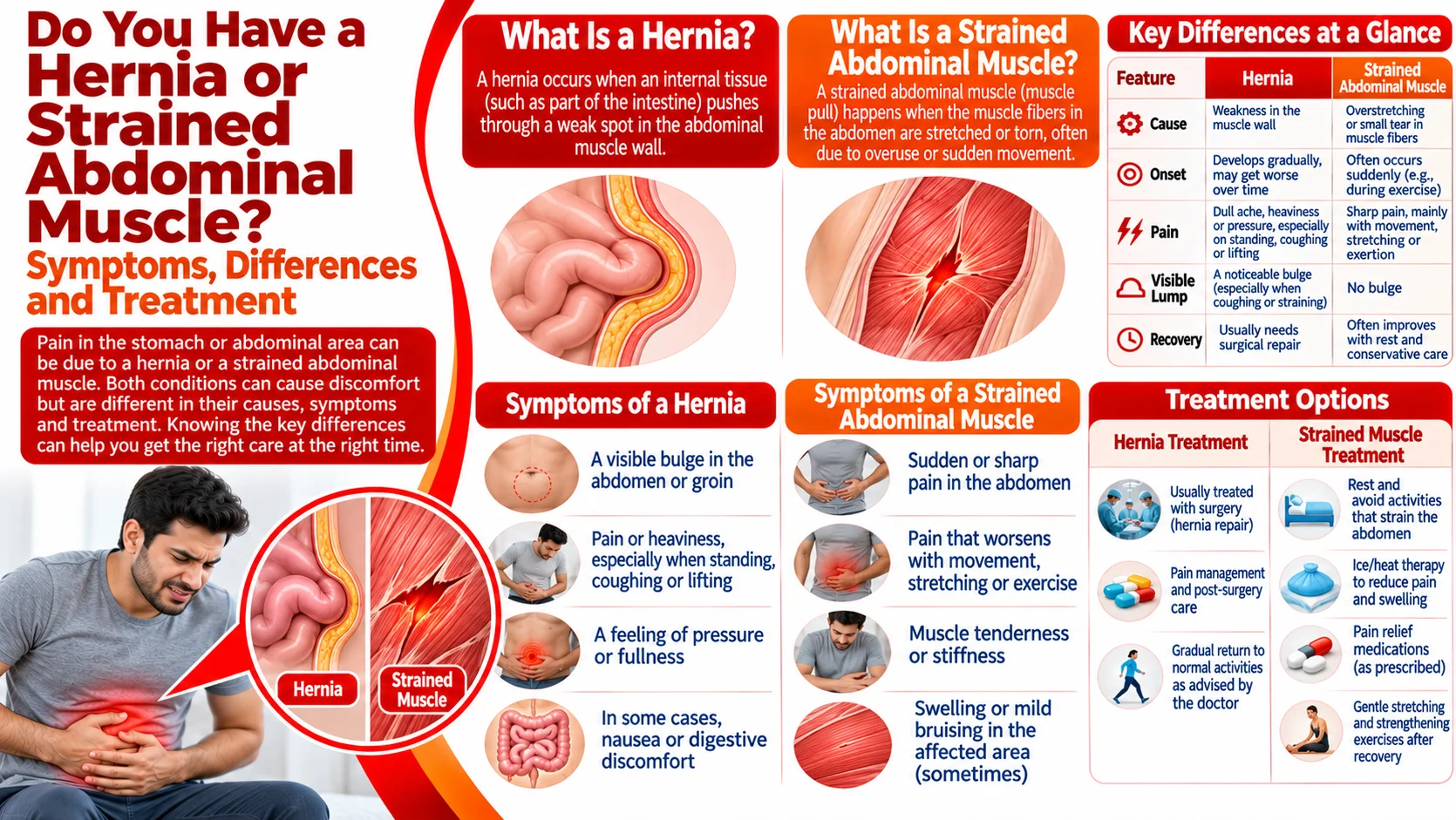
Both conditions can cause abdominal discomfort, particularly after physical activity. However, their symptoms, underlying causes, and treatments are different.
These differences can help you understand the possible cause of abdominal pain, but they cannot confirm a diagnosis. A muscle strain can be quite painful, while some hernias cause very little discomfort. A hernia may also be present without an obvious lump.
What Causes an Abdominal Muscle Strain?
A pulled abdominal muscle usually occurs when the muscles are exposed to more force or stretching than they can tolerate.
Common causes include:
-
Lifting heavy weights without proper technique.
-
Performing too many sit-ups or abdominal exercises.
-
Sudden twisting during sports or exercise.
-
Repeated or forceful coughing.
-
Lifting heavy household items.
-
Returning to intense exercise without adequate preparation.
-
Sudden movements that stretch the abdominal muscles beyond their usual range.
Pregnancy and the period after childbirth can also place additional demands on the abdominal muscles. Certain physical activities during recovery may contribute to muscle discomfort or strain.
What Causes a Hernia?
A hernia develops when there is a weak area in the abdominal wall. This weakness may be present from birth or develop over time because of ageing, previous surgery, or changes in the abdominal muscles and connective tissues.
Several factors can increase the risk of developing or noticing a hernia:
-
Frequently lifting heavy objects.
-
Long-term constipation and repeated straining.
-
Persistent coughing.
-
Being overweight or obese.
-
Pregnancy.
-
Previous abdominal surgery.
-
A family history of hernias.
-
Increasing age and weakening of the abdominal wall.
Lifting something heavy does not automatically mean you have a hernia. However, physical strain can make an existing weak area more noticeable or bring symptoms to attention.
How Do Doctors Diagnose a Hernia or Abdominal Muscle Strain?
The diagnosis begins with a review of your symptoms and medical history, followed by a physical examination.
Your doctor may ask:
-
When did the abdominal pain begin?
-
Did it start after lifting something heavy or exercising?
-
Does the pain increase when coughing, bending, or standing?
-
Have you noticed a lump around your abdomen or groin?
-
Have you undergone abdominal surgery in the past?
-
Does the discomfort improve when you lie down?
During the examination, the doctor may ask you to stand, cough, or change positions. These movements can help make a hernia bulge more noticeable. If a hernia is suspected but cannot be confirmed through physical examination, an ultrasound may be recommended. A CT scan or other imaging test may be considered when the diagnosis remains unclear or when further assessment is needed.
For a suspected abdominal muscle strain, the doctor generally checks for tenderness, pain during movement, and signs of muscle injury. Imaging is not always necessary for a straightforward muscle strain. The exact tests depend on your symptoms and the findings during examination.
What Is the Treatment for a Hernia or Abdominal Muscle Strain?
Treatment depends on the underlying condition. An abdominal muscle strain and a hernia should not be managed in the same way.
Treatment for an Abdominal Muscle Strain
Most mild abdominal muscle strains improve without surgery. Treatment generally focuses on reducing discomfort and allowing the injured muscles to recover.
It may include:
-
Rest: Temporarily avoid heavy lifting and movements that increase the pain.
-
Cold application: Applying an ice pack wrapped in a cloth may help reduce pain and swelling during the early stage of injury.
-
Gradual movement: Return to normal activities slowly as the pain improves.
-
Pain relief: A doctor may recommend suitable pain-relieving medication when needed.
-
Physiotherapy: Specific stretching and strengthening exercises may help during recovery, depending on the severity of the strain.
Avoid returning to intense workouts or lifting heavy weights before the muscles have recovered. If the pain is severe, persistent, or worsening, seek medical assessment rather than assuming it is a simple strain.
Treatment for a Hernia
A hernia requires evaluation by a general surgeon. The treatment depends on its location, size, symptoms, risk of complications, and the patient's overall health. Some small, minimally symptomatic hernias may be monitored under medical supervision after discussing the potential risks. This approach is often called watchful waiting.
When surgery is recommended, the surgeon may consider:
-
Open hernia repair: The surgeon makes an incision near the hernia, returns the protruding tissue to its appropriate position, and repairs the weakened area.
-
Laparoscopic hernia repair: The surgeon uses small incisions and a camera to repair the hernia. A mesh may be used to reinforce the weakened abdominal wall.
The most appropriate surgical technique depends on the type of hernia, its size, the patient's medical condition, and the surgeon's assessment. An abdominal belt or exercise routine cannot repair the weakened abdominal wall. Do not try to push back a painful or trapped bulge yourself.
When Is a Hernia an Emergency?
A hernia can become dangerous if the protruding tissue gets trapped and cannot return to its normal position. This is known as an incarcerated hernia. If the blood supply to the trapped tissue becomes restricted, it can lead to a strangulated hernia. A strangulated hernia requires immediate medical attention and may need emergency surgery.
Go to the nearest emergency department if you notice:
-
Sudden or severe pain around the hernia bulge.
-
A bulge that becomes hard, very tender, or changes colour.
-
A bulge that no longer becomes smaller when lying down.
-
Nausea or repeated vomiting.
-
Abdominal swelling or severe discomfort.
-
Inability to pass stool or gas.
-
Fever along with worsening abdominal pain.
Do not wait for the symptoms to improve or try to force a painful, trapped bulge back inside. Seek emergency medical care immediately.
How Can You Reduce the Risk of Abdominal Muscle Strain and Hernia?
Not every hernia or muscle injury can be prevented. However, some practical measures may help reduce unnecessary strain on the abdominal muscles and abdominal wall.
-
Warm up before exercise or strength training.
-
Use the correct technique when lifting weights or heavy objects.
-
Increase exercise intensity gradually.
-
Avoid lifting loads that exceed your physical capacity.
-
Maintain a healthy body weight.
-
Eat a fibre-rich diet and drink enough water to help prevent constipation.
-
Seek medical advice for persistent coughing.
-
Follow your surgeon's instructions after abdominal surgery.
-
Resume exercise gradually after pregnancy or childbirth, following appropriate medical guidance.
If you already have a diagnosed hernia, ask your surgeon which activities are safe for your condition.
Conclusion
An abdominal muscle strain and a hernia can both cause pain after lifting something heavy, exercising, or making sudden movements. However, they are different conditions. Muscle strain usually causes soreness and tenderness in the affected muscles, while a hernia may cause a bulge, pressure, or discomfort near a weak area of the abdominal wall.
Most mild muscle strains improve with appropriate rest and gradual recovery. A hernia, however, does not usually heal on its own and may require monitoring or surgical repair depending on its symptoms and type. If you have persistent abdominal pain, notice a new lump, or experience discomfort while coughing or lifting, consult a general surgeon for an accurate diagnosis.
At SCI International Hospital, Dr. Asif Umar, General, Laparoscopic & Bariatric Surgeon, provides evaluation and surgical care for different types of hernias. With around 20 years of experience, he specialises in general surgery and advanced laparoscopic procedures.
For more information, visit the Hernia Surgery department at SCI International Hospital.
Frequently Asked Questions About Hernia and Abdominal Muscle
1. How can I tell if I have a pulled abdominal muscle or a hernia?
A pulled abdominal muscle usually causes soreness, tightness, and tenderness that may worsen when bending, twisting, or sitting up. A hernia may cause a bulge around the abdomen, belly button, or groin, particularly when coughing or standing. However, some hernias do not produce an obvious lump, so a medical examination may be needed.
2. Can you strain an abdominal muscle while weightlifting?
Yes. Lifting weights that are too heavy, using improper technique, or making sudden movements can overstretch or injure the abdominal muscles. Warming up and increasing exercise intensity gradually can help reduce the risk.
3. Can a hernia disappear without surgery?
A hernia generally does not close or heal on its own. However, some selected patients with small or minimally symptomatic hernias may be managed through regular medical monitoring. A surgeon should determine whether observation or surgical repair is appropriate.
4. Can an abdominal muscle strain cause a lump?
A muscle strain may cause local swelling or bruising, but it does not typically produce the protruding lump associated with a hernia. If you notice a new or persistent bulge, consult a doctor to identify its cause.
5. Does a hernia always cause pain?
No. Some hernias cause a visible bulge without significant pain, while others may produce pressure, heaviness, or discomfort during physical activity. The absence of pain does not rule out a hernia.
6. When should I see a doctor for abdominal pain?
Consult a doctor if abdominal pain persists, worsens, or is accompanied by a new lump. Seek emergency care if you experience severe pain, vomiting, fever, abdominal swelling, or difficulty passing stool or gas, particularly if you have a known or suspected hernia.
7. Can exercise make a hernia worse?
Some exercises, particularly heavy lifting and activities that increase pressure inside the abdomen, may make hernia symptoms more noticeable. If you have a diagnosed hernia, consult your surgeon before continuing strenuous exercise.