Painful periods are not unusual, and many women with cramps suffer innocuous aches and pains. All you are likely to notice is a dull pain in your lower abdomen that comes and goes, or you might have some slight bloating or backache. Most women are still able to do their normal daily routines.
Concern is warranted when the cramps aren’t normal. Pain can start days before your period and can even last well after the flow is finished. There can also be worsening pain with each cycle. Sex, pooping, or even peeing can also cause pain. While these could be symptoms of just bad cramps or PMS, endometriosis is also a possibility. Any of these should prompt you to see a gynecologist.
What Do Normal Period Cramps Usually Feel Like?
Menstrual cramps occur due to contractions of the uterus. Women feel pain in their lower abdomen, and the pain can even radiate to the lower back and legs.
Usually, the pain is worst at the start of the menstruation cycle, and a heating pad, resting, and normal pain medicine can provide some relief.
Expect other symptoms to go along with the worst pain of menstrual cramps, such as bloating, feeling tired, having a headache, nausea, and/or having loose stools. These symptoms can be a pain to deal with, but do not provide enough medical cause to be concerned.
Pay more attention to your normal pattern of these symptoms. If you generally have a normal menstrual cycle with this constant pattern of pain, then the pain is just a normal part of having your menstrual cycle.
When Can Period Pain Be a Sign of Endometriosis?
Endometriosis can cause pain that feels a lot like severe period cramps. One of the differences is that the pain is not always limited to the days of your period.
It may begin before the bleeding starts and continue afterwards. Some women also have pelvic pain between periods. If the pain has become harder to manage over time, that is another reason to get it checked.
Endometriosis can also cause pelvic pain and painful periods, although the symptoms can vary from one woman to another.
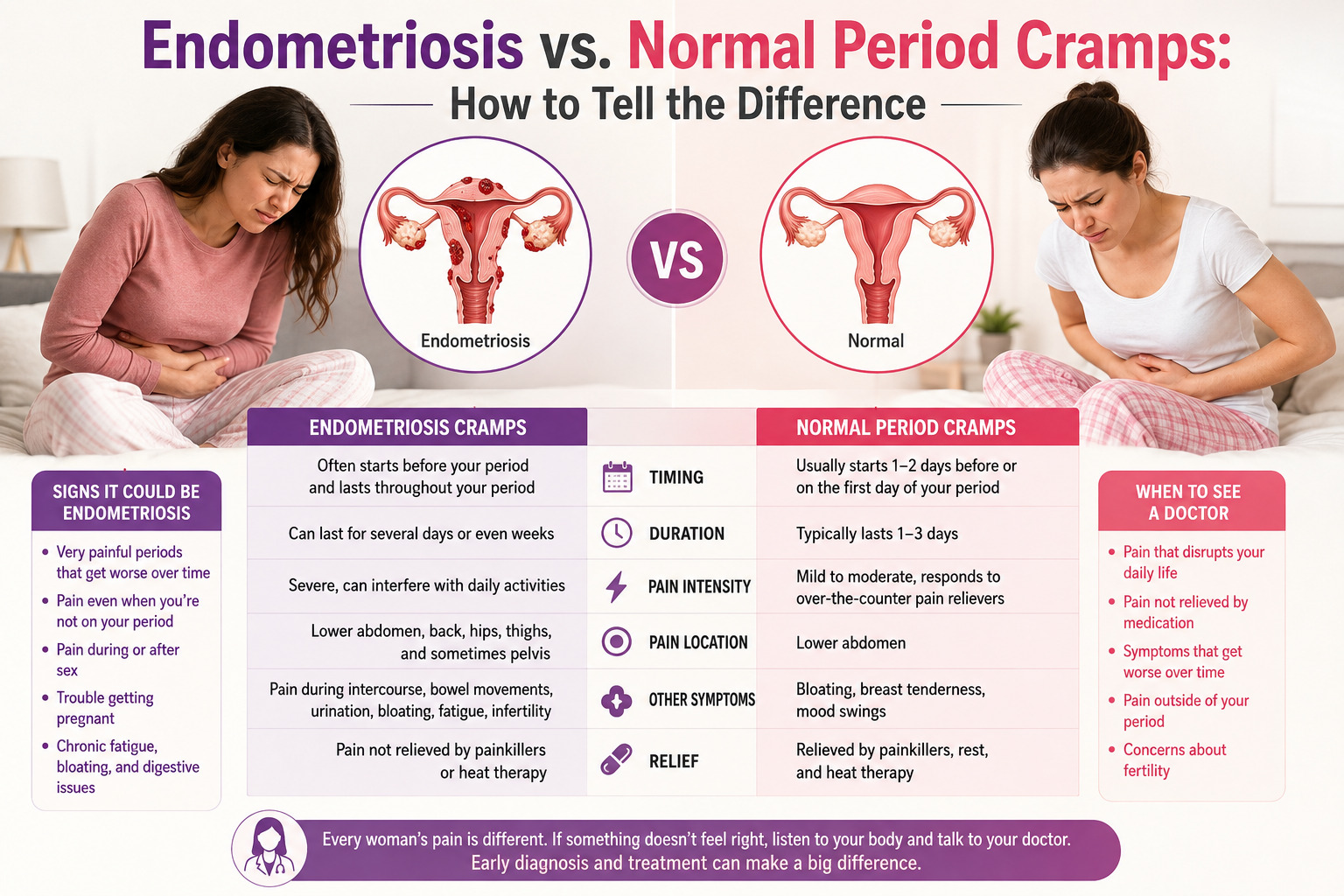
Normal Period Cramps vs. Endometriosis Pain
This is only a general guide. Pain alone cannot confirm endometriosis. Some women have severe pain with the condition, while others may have fewer symptoms.
How Do You Know If Your Period Pain Is Too Much?
Normal period cramps don't have a universal definition. The best way to tell is to consider whether the pain is allowing you to do your normal daily activities. If it is just a mild discomfort and you can still work, study, sleep, and do your activities of daily living, it might be a normal part of your period.
However, if you miss work and college regularly, cancel your activities, stay in bed, and need to take pain medication to get through the day, you should talk to a doctor. This is also helpful if you notice your pain is getting worse rather than better every month.
Can Endometriosis Cause Pain Outside Your Period?
Yes. It is among the signs that can cause endometriosis to be different from regular menstrual cramps.
There is a possibility that you are experiencing lower back or pelvic discomfort between menstrual cycles. Many women experience discomfort after or during sexual activities. The pain when passing stool or urinating is also a possibility, particularly during the period.
Unusual or frequent bleeding, constipation, bloating, and diarrhoea may also be present. These symptoms may have various causes, and therefore are not proof of the existence of endometriosis.
If you are also having pain during intercourse along with painful periods or pelvic pain, it is worth discussing both with a gynaecologist.
Can Endometriosis Affect Fertility?
It could, however, not be that all women with endometriosis have difficulty getting pregnant.
Endometriosis can cause problems with the ovaries, fallopian tubes, as well as the tissues around those reproductive organs. In some instances, scar tissue or inflammation can hinder conception.
If you're trying to get pregnant and you also experience painful periods or persistent pelvic pain, you should mention these signs when you are having your fertility consultation. Severe period pain and pelvic pain might be an indication that your doctor is trying to determine the root cause.
Does Endometriosis Always Get Worse?
Not necessarily.
Not all women experience the same type of symptoms, nor do they have the same level of discomfort. Some women feel worse over time; others feel better at times.
What you need to think about is more about you. Are your symptoms changing? If you start to experience pain during the month outside of your period of pain, that should be looked into and not just attributed to getting older.
How Is Endometriosis Diagnosed?
Your symptoms are usually the starting point.
Your gynaecologist will ask about the pain's starting point, how long the pain lasts, and if it ever happens outside of your period. Pain during sex, pain when sitting, passing blood clots, stool/blood with stool, trouble urinating, and issues getting pregnant are other things you may be asked about.
Depending on your symptoms, you may have to do a pelvic exam and/or an ultrasound. Sometimes you have to do other tests and/or laparoscopy.
Endometriosis doesn't have one main symptom.
How Is Endometriosis Treated?
Treatment depends on your symptoms and whether you are planning a pregnancy.
Some women may get relief with pain medicines. Hormonal treatment can also help control periods and reduce pain.
If the symptoms continue despite medicines, or there are concerns such as endometriosis-related cysts, adhesions or fertility problems, surgery may be considered. Depending on the situation, treatment may include medicines, hormonal treatment or laparoscopic surgery for endometriosis.
When Should You See a Gynaecologist?
You do not have to wait for discomfort to be extreme.
It is good to check if:
- Pain hinders you from daily activities.
- Pain is increasing over time.
- Pain starts before your period or continues after your period.
- You have pain in your pelvis during/between periods.
- Pain occurs with sex.
- Pain happens during passing stool or urination.
- Your periods are very heavy.
- Your ability to conceive is impacted.
It may also be beneficial to keep a list of your pain and symptoms for a few months to help you show the doctor the pattern you notice. Include starting time, pain duration, and symptoms that happen with the pain.
Conclusion
Some period pain is normal, but you should not have to put your life on hold every month because of it. Pain that starts before your period, continues afterwards, becomes worse over time, or comes with pain during sex, bowel movements or urination deserves a closer look. These symptoms do not automatically mean endometriosis, but they are a good reason to speak with a gynaecologist. At SCI International Hospital, a multispecialist hospital, Dr. Dhwani Mago, Obstetrician, Gynaecologist and Infertility Specialist with 17+ years of experience, provides care for endometriosis and other gynaecological conditions.
FAQs
Q- How can I tell if my period cramps are because of endometriosis?
Ans- Normal period cramps begin when you start your period and, for most people, improve within a few days. Pain from endometriosis starts before, after, in between, and during the periods and can worsen while doing your daily activities.
Q- Does having bad period cramps automatically mean I have endometriosis?
Ans-Not necessarily. There are many other possible causes of bad period cramps; however, if your bad period cramps start to disrupt your routine, your sleep, your studies, or your work, then this should be checked by a medical professional.
Q- Does endometriosis cause pain during sexual intercourse?
Ans- Pain during sex is common among people with endometriosis. It also occurs during painful periods and/or chronic pelvic pain.
Q- Does endometriosis affect fertility?
Ans- Being diagnosed with endometriosis doesn't automatically mean that fertility will be compromised. It is case-dependent.
Q- When should I go see a gynecologist for period pain?
Ans- You should see a gynecologist for period pain that worsens, pain that lasts outside of your period, painful sex, painful urination or bowel movements during your period.