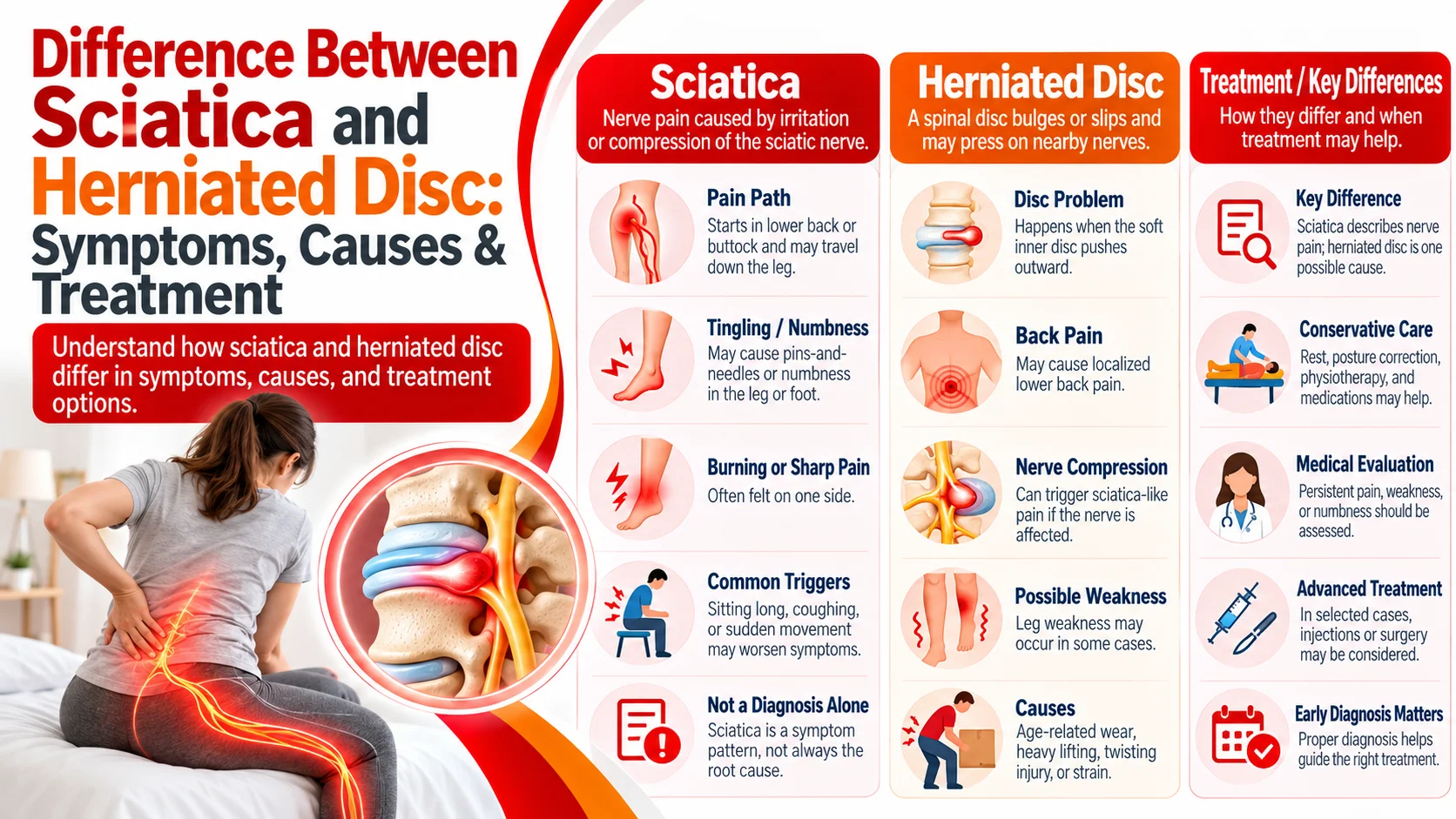
Lower back pain that travels into the buttock or leg can sometimes be difficult to understand. Sciatica and a herniated disc can cause similar symptoms, but they are not the same condition.
Sciatica describes pain and other nerve-related symptoms along the path of the sciatic nerve, while a herniated disc is a structural problem involving one of the discs between the vertebrae.
A herniated disc can cause sciatica when it irritates or compresses a nearby nerve, but not every case of sciatica is caused by a herniated disc, and not every herniated disc causes symptoms.
Understanding the difference can help you recognise when medical evaluation may be appropriate.
What Is Sciatica?
Sciatica refers to pain or other symptoms caused by irritation or compression of the sciatic nerve or its nerve roots.
The sciatic nerve is formed by nerve roots in the lower spine and travels through the buttocks and down each leg.
Sciatica commonly affects one side of the body. Symptoms may extend from the lower back or buttock into the thigh, calf and foot.
Common symptoms include:
- Pain that travels from the lower back or buttock into the leg
- Burning, sharp or electric-like pain
- Tingling or pins and needles
- Numbness
- Weakness in the leg or foot
- Pain that may become worse with sitting, coughing or sneezing
Sciatica is a symptom pattern rather than a single disease. It can have several possible causes, including a herniated disc, spinal stenosis and other conditions affecting the nerves.
What Is a Herniated Disc?
A herniated disc, sometimes called a slipped or prolapsed disc, occurs when the inner material of a spinal disc pushes through a weakened or damaged outer portion. Spinal discs sit between the vertebrae and help absorb shock while allowing the spine to move.
A herniated disc may:
- Cause local back or neck pain
- Irritate or compress a nearby nerve
- Cause pain that travels into an arm or leg
- Cause numbness or tingling
- Cause muscle weakness
- Cause no symptoms at all
The symptoms depend on the location of the affected disc and whether nearby nerves are involved.
Sciatica vs. Herniated Disc: What Is the Difference?
The simplest way to understand the difference
Sciatica describes what the irritated nerve is causing. A herniated disc describes one possible structural reason why the nerve may be irritated.
Can a Herniated Disc Cause Sciatica?
Yes. A lumbar herniated disc can press against or irritate a nearby nerve root that contributes to the sciatic nerve. This may cause pain, tingling, numbness or weakness that travels from the lower back or buttock into the leg.
However, a herniated disc is only one possible cause of sciatica. Spinal stenosis and other conditions can also irritate the nerves responsible for sciatic symptoms.
How Are the Symptoms Different?
There can be considerable overlap between sciatica and symptoms caused by a herniated disc.
Sciatica
Sciatica commonly involves:
- Pain travelling into the buttock and leg
- Tingling or numbness in the leg or foot
- Burning or electric-like pain
- Possible weakness
- Symptoms often affecting one side
Herniated Disc
A herniated disc may cause:
- Localised back or neck pain
- Arm pain if a cervical disc affects a nerve
- Leg pain if a lumbar disc affects a nerve
- Numbness or tingling
- Muscle weakness
- No symptoms in some people
Therefore, leg pain alone does not prove that you have a herniated disc. A medical assessment is needed to determine the likely cause.
How Are Sciatica and a Herniated Disc Diagnosed?
Your doctor will usually begin by asking about your symptoms and medical history.
A physical examination may assess:
- Muscle strength
- Sensation
- Reflexes
- Walking and movement
- Spine and leg movement
- Signs of nerve irritation or compression
Imaging is not always required immediately, particularly when symptoms are mild and improving. If symptoms persist, become severe, or suggest significant nerve compression, your doctor may recommend an MRI of the spine or another appropriate investigation.
An MRI can show disc herniation, spinal stenosis and other structural changes. However, an abnormal MRI finding does not automatically mean that it is the cause of your pain. Imaging findings should be interpreted together with your symptoms and physical examination.
How Are Sciatica and Herniated Disc Treated?
Treatment depends on the underlying cause, severity of symptoms and whether there is neurological impairment. SCI Hospital provides orthopedic care in Delhi for a range of musculoskeletal conditions, with both non-surgical and surgical treatment options available when clinically appropriate.
Depending on the situation, treatment may include:
- Pain-relieving medicines
- Physiotherapy
- Stretching and strengthening exercises
- Activity modification
- Maintaining appropriate physical activity
- Treatment for the underlying spinal condition
- Other specialist-recommended pain management options
Surgery may be considered in selected cases when symptoms do not improve with appropriate conservative treatment or when there is significant or progressive neurological weakness.
SCI Hospital provides orthopaedic and spine-related specialist care, including treatment options ranging from non-surgical management to advanced surgical procedures when clinically indicated. Its current doctor profiles include spine specialists with expertise in conditions such as lumbar disc disease, herniated disc and spinal surgery.
When Should You See a Doctor for Sciatica or Back Pain?
You should consider medical evaluation if you have:
- Back pain that persists or keeps returning
- Severe pain travelling down the leg
- Increasing numbness or tingling
- Weakness in the leg or foot
- Difficulty walking
- Symptoms that interfere with normal activities
- Pain that is not improving with appropriate self-care
When Is Sciatica an Emergency?
Seek urgent medical attention if you develop:
- Loss of bladder or bowel control
- New difficulty passing urine
- Numbness around the groin, genitals or inner thighs
- Severe or rapidly worsening weakness in the legs
These symptoms can indicate serious nerve compression and require prompt assessment.
Can Sciatica Get Better Without Surgery?
Yes, many cases of sciatica improve without surgery. The recovery depends on the underlying cause and severity of the nerve irritation.
For example, symptoms related to a herniated disc may improve as the inflammation around the affected nerve settles and the condition improves.
However, persistent pain, worsening numbness or weakness should not be ignored. A doctor can determine whether further evaluation or treatment is necessary.
Can You Have a Herniated Disc Without Sciatica?
Yes. A person can have a herniated disc without experiencing sciatic pain. If the disc does not affect a nearby nerve, there may be no noticeable symptoms or there may only be local back or neck discomfort.
This is also why an MRI report should not be interpreted in isolation. The structural findings need to be considered alongside the patient's symptoms and physical examination.
Can a Herniated Disc Heal Without Surgery?
In many cases, symptoms from a herniated disc can improve with non-surgical treatment.
Depending on the patient's condition, treatment may involve:
- Medication
- Physiotherapy
- Activity modification
- Exercise-based rehabilitation
- Specialist monitoring
Surgery may be considered when symptoms remain severe despite appropriate conservative treatment or when there is significant or progressive neurological impairment. The appropriate treatment should be decided after an individual medical evaluation.
Conclusion
Sciatica and a herniated disc are related but are not the same condition. Sciatica describes pain and other symptoms caused by irritation or compression of nerves that contribute to the sciatic nerve, while a herniated disc is a structural problem involving a spinal disc.
A herniated disc can cause sciatica, but other spinal conditions can also produce sciatic symptoms. Similarly, a herniated disc may exist without causing any symptoms. Accurate diagnosis is important because treatment depends on the underlying cause and may include medication, physiotherapy, activity modification, pain management or surgery when clinically necessary.
At SCI International Hospital, a multispeciality hospital in Delhi, patients can access orthopedic care in Delhi for spinal and musculoskeletal conditions. For specialist evaluation, patients can consult a spine and neurosurgery specialist with expertise in spinal disorders, herniated discs, lumbar and cervical disc disease, and spinal disc surgery. SCI Hospital also has Dr. Mandeep Singh, Orthopedic and Spine Surgeon, who specialises in spine surgery and related musculoskeletal conditions.
FAQs About Sciatica vs. Herniated Disc
Is sciatica the same as a slipped disc?
No. Sciatica describes nerve-related symptoms, usually involving pain or other sensations travelling along the sciatic nerve. A slipped or herniated disc is one possible cause of nerve irritation that can result in sciatica.
Can you have sciatica without a herniated disc?
Yes. Sciatica can have several causes, including spinal stenosis and other conditions that irritate or compress the relevant nerves.
Does every herniated disc cause symptoms?
No. Some people have a herniated disc without experiencing noticeable symptoms. The significance of an MRI finding depends on the person's symptoms and clinical examination.
Does a herniated disc always require surgery?
No. Many people improve with non-surgical treatment. Surgery may be considered when symptoms remain severe despite appropriate treatment or when significant or progressive neurological problems develop.
How long does sciatica take to get better?
Recovery varies depending on the underlying cause, severity and individual health factors. Many cases improve over time with appropriate conservative treatment, but persistent or worsening symptoms should be medically assessed.
What symptoms of sciatica require emergency care?
Loss of bladder or bowel control, new difficulty passing urine, numbness around the groin or inner thighs, or severe and rapidly worsening leg weakness require urgent medical assessment.
Can an MRI confirm that a herniated disc is causing my sciatica?
An MRI can show a herniated disc and other structural abnormalities, but the scan alone cannot always establish the cause of pain. Doctors interpret MRI findings together with symptoms and physical examination.