An ACL tear is a common knee injury that can cause pain, swelling, difficulty walking and a feeling that the knee may give way. After an ACL injury is diagnosed, one of the most common questions is: “Do I need ACL surgery, or can I recover without surgery?”
The answer depends on several factors, including the severity of the tear, knee stability, associated injuries, activity level, age, and your goals for recovery.
Some people can manage an ACL injury with physiotherapy, rehabilitation and activity modification, while others may benefit from ACL reconstruction surgery. Understanding the available treatment options can help you discuss the most appropriate approach with an orthopaedic specialist.
What Is an ACL Tear?
The anterior cruciate ligament (ACL) is one of the major ligaments that helps stabilise the knee. It is particularly important during activities that involve running, jumping, landing and sudden changes in direction.
An ACL injury can occur because of:
- Sudden twisting of the knee
- Awkward landing after a jump
- Rapid change in direction
- Sports-related injury
- A direct blow to the knee
- Falls or other traumatic injuries
An ACL tear may be partial or complete, and other knee structures, including the meniscus or other ligaments, may also be injured at the same time.
Common ACL Tear Symptoms
An ACL injury may cause:
- Knee pain
- Swelling
- Difficulty walking
- Reduced knee movement
- Difficulty bending or straightening the knee
- A feeling that the knee may give way
- Knee instability during turning or changing direction
- Reduced confidence when putting weight on the leg
Not every person experiences all of these symptoms.
ACL Tear Symptoms by Stage
Symptoms can change as the initial injury settles.
Can an ACL Tear Heal Without Surgery?
Not every ACL tear requires surgical reconstruction. Some people can achieve good knee function with structured physiotherapy, rehabilitation and activity modification, particularly when the knee becomes stable and the person's activities do not place high demands on the ACL.
Non-surgical treatment may be considered depending on:
- The type and severity of the ACL injury
- Knee stability
- Whether other knee structures are injured
- The person's activity level
- Work requirements
- Sports participation
- Long-term functional goals
Not having surgery does not mean doing nothing. Rehabilitation remains important for improving knee movement, strength, balance, stability and control.
What Is Non-Surgical ACL Treatment?
Non-surgical ACL treatment may include:
- Physiotherapy
- Strengthening exercises
- Range-of-motion exercises
- Balance and coordination training
- Activity modification
- Gradual return to normal activities
- Management of pain and swelling
Initially, rehabilitation may focus on reducing swelling and restoring knee movement. Later, the focus generally shifts toward strengthening the muscles around the knee and improving balance and movement control.
Some people can function well without ACL reconstruction, particularly when their activity demands are lower and their knee remains stable with rehabilitation.
ACL Recovery After Surgery
ACL reconstruction surgery involves replacing the damaged ligament with a tissue graft to help restore knee stability. The procedure is commonly performed using arthroscopic techniques, which involve small incisions and specialised instruments.
SCI Hospital's current ACL reconstruction service describes arthroscopic ACL reconstruction, MRI-based assessment, orthopaedic evaluation and structured physiotherapy/rehabilitation as part of its treatment pathway.
When Is ACL Surgery Considered?
ACL reconstruction may be discussed when:
- The knee repeatedly gives way
- Significant instability continues despite rehabilitation
- You want to return to sports involving jumping, pivoting or sudden changes in direction
- There is an associated meniscus or ligament injury
- Your work requires a stable knee
- Your activity goals cannot be safely achieved with non-surgical treatment
The decision is individual. An ACL tear on an MRI does not automatically mean that surgery is necessary.
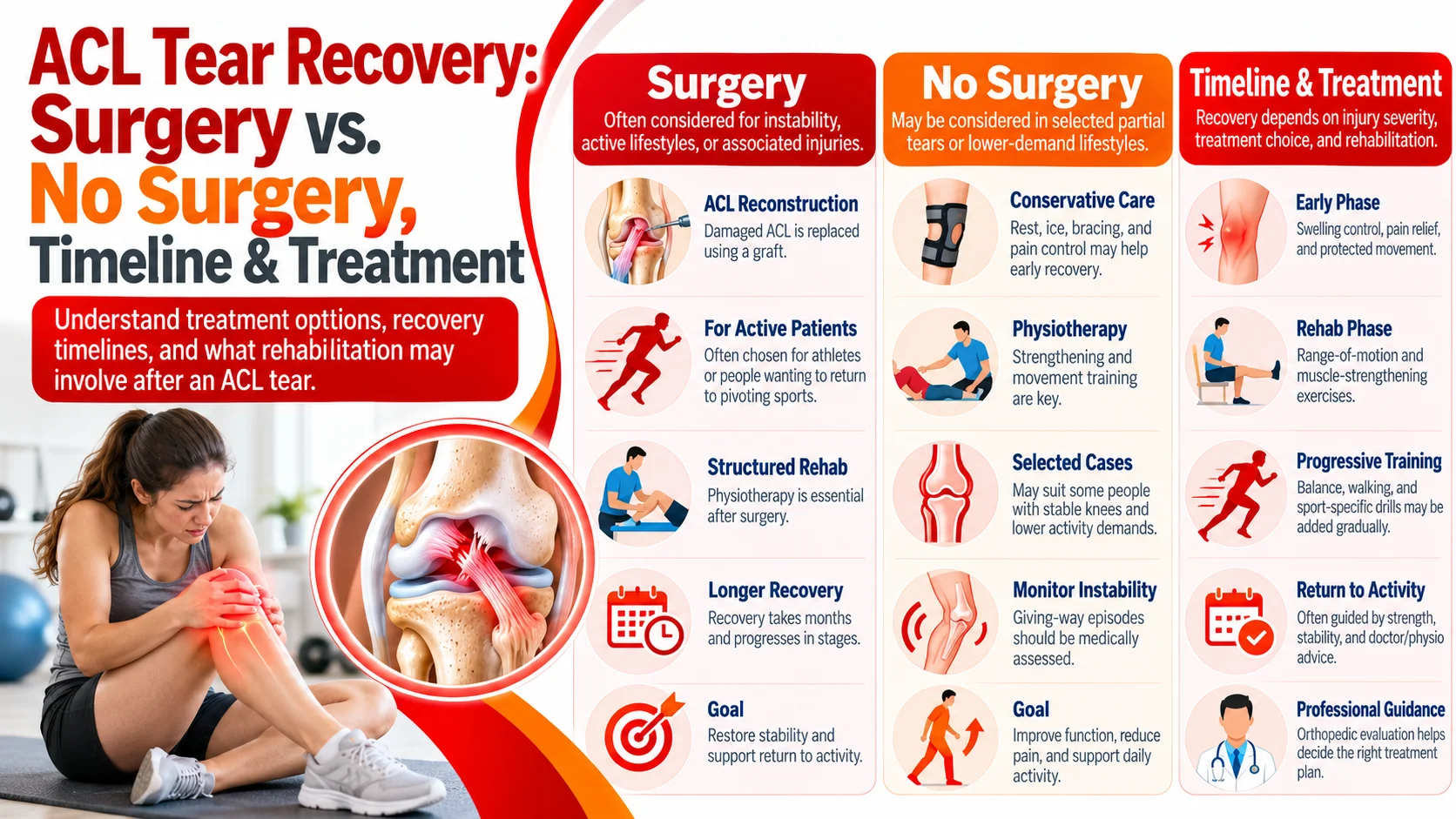
ACL Tear Recovery: Surgery vs. No Surgery
The decision should not simply be “surgery or no surgery.” The more important question is: Can the knee remain stable and function safely for the activities you want to perform?
Who May Need ACL Surgery?
ACL reconstruction may be considered when the knee remains unstable or when a person wants to return to activities that place high demands on the knee.
This may include:
- Recurrent episodes of the knee giving way
- Sports involving pivoting or sudden direction changes
- Football, badminton, basketball and similar activities
- Associated meniscus or ligament injuries
- Persistent instability despite physiotherapy
- Work that requires frequent turning, climbing or physically demanding movements
For example, a person who wants to return to competitive football may have different treatment goals from someone whose primary goal is comfortable walking and performing daily activities.
SCI's current ACL reconstruction page specifically lists sports-related ACL injuries and knee instability among reasons for specialist assessment.
Who May Recover Without ACL Surgery?
Some people can manage an ACL injury without reconstruction. Non-surgical management may be considered when:
- The knee becomes sufficiently stable with rehabilitation
- Activity demands are relatively low
- The person does not participate in high-demand pivoting sports
- There are no associated injuries requiring surgery
- The person's functional goals can be achieved without reconstruction
However, the decision should be made after a proper orthopaedic assessment.
Feeling better does not always mean that the ACL or knee has fully recovered. Some people may continue to experience instability during specific movements.
ACL Recovery Timeline After Surgery
ACL recovery takes time, and rehabilitation progresses in stages.
The exact timeline varies according to the surgical procedure, associated injuries, rehabilitation progress and individual recovery.
SCI's current ACL reconstruction page notes that return to sports may take approximately six to nine months, depending on rehabilitation progress and medical evaluation.
How Long Does ACL Tear Recovery Take?
ACL tear recovery time varies from person to person. With non-surgical treatment, symptoms and function may improve over several weeks or months, depending on the severity of the injury and response to rehabilitation.
After ACL reconstruction, recovery generally takes several months. Returning to everyday walking usually occurs earlier than returning to running, pivoting sports or other high-demand activities.
Returning to sports should be based on strength, movement control, knee stability and medical/rehabilitation assessment, rather than simply the number of months since surgery. Rushing back to sports before the knee is adequately rehabilitated may increase the risk of further injury.
Can a Torn ACL Heal on Its Own?
This question needs some clarification. A torn ACL does not reliably return to its original normal structure on its own, particularly after a complete tear. However, some people can achieve good functional outcomes without ACL reconstruction.
This may happen when the knee becomes functionally stable with rehabilitation and the person's activity demands are compatible with the stability of the knee. If instability continues, particularly during sports or turning movements, an orthopaedic specialist may discuss whether reconstruction is appropriate.
Is Physiotherapy Needed After an ACL Tear?
Yes. Physiotherapy and rehabilitation are important whether or not surgery is performed.
Rehabilitation may help improve:
- Knee range of motion
- Leg strength
- Balance
- Knee control
- Walking pattern
- Muscle coordination
- Confidence while using the injured leg
After ACL reconstruction, rehabilitation is particularly important for gradually restoring strength and functional movement before returning to demanding activities. SCI's ACL reconstruction service also describes structured rehabilitation and physiotherapy as part of recovery after surgery.
When Should You See an Orthopaedic Doctor?
You should consider an orthopaedic evaluation if pain, swelling or instability continues after a knee injury.
A specialist may assess:
- Knee movement
- Ligament stability
- Muscle strength
- Swelling
- Walking pattern
- Associated knee symptoms
- Sports or activity requirements
An MRI scan may be recommended when clinically appropriate to evaluate the ACL and identify associated injuries involving the meniscus, cartilage or other ligaments.
SCI Hospital's ACL service states that clinical examination and MRI assessment may be used to evaluate ligament damage before deciding whether reconstruction is appropriate.
ACL Tear Treatment at SCI Hospital
SCI International Hospital provides ACL reconstruction surgery in Delhi as part of its orthopaedic and sports injury services.
The hospital's current ACL service includes orthopaedic evaluation, MRI assessment when required, arthroscopic techniques and rehabilitation planning. Its listed ACL specialists include Dr. Mandeep Singh, along with other orthopaedic specialists.
For broader musculoskeletal evaluation and treatment, SCI also provides orthopedic care in Delhi covering knee injuries, arthroscopy, ACL reconstruction, meniscus repair and other orthopaedic conditions.
Conclusion
An ACL tear does not automatically mean that surgery is required. Some people can achieve good functional recovery through physiotherapy, rehabilitation and activity modification, while others may benefit from ACL reconstruction because of persistent instability, associated knee injuries or the need to return to high-demand sports and activities.
The decision between surgery and non-surgical treatment should consider the type of ACL injury, knee stability, associated injuries, activity level and individual recovery goals.
At SCI International Hospital, a multispeciality hospital in Delhi, patients can receive orthopaedic evaluation and treatment for ACL injuries. SCI provides orthopedic care in Delhi and specialised ACL reconstruction surgery in Delhi, along with rehabilitation-focused care.
Patients seeking specialist evaluation can also consult Dr. Mandeep Singh, Orthopedic and Spine Surgeon, whose current SCI profile identifies his orthopaedic and spine surgery expertise.
FAQs About ACL Tear Recovery
Can a complete ACL tear heal without surgery?
Some people can function well without ACL reconstruction, particularly when the knee becomes stable through rehabilitation and their activity requirements are lower. However, a complete ACL tear does not reliably restore the ligament to its original structure on its own.
What is the average ACL surgery recovery time?
ACL reconstruction recovery generally takes several months. Returning to everyday activities usually occurs earlier than returning to demanding sports. SCI's current ACL page states that return to sports may take approximately six to nine months, depending on rehabilitation and medical evaluation.
Is physiotherapy necessary after an ACL injury?
Yes. Physiotherapy is an important part of ACL recovery both with and without surgery. It can help improve knee movement, strength, balance, stability and functional control.
Is surgery necessary for a complete ACL tear?
Not always. The decision depends on factors such as knee stability, associated injuries, activity level, sports requirements and treatment goals.
Can I still play sports after an ACL tear?
Some people can return to sports after appropriate rehabilitation, while others may need to modify or avoid high-demand activities depending on knee stability. After reconstruction, return to sports should occur gradually after appropriate strength and functional assessment.
What happens if an ACL tear is left untreated?
Some people can function without reconstruction, but persistent knee instability can affect activity and may contribute to additional knee problems in some cases. An orthopaedic evaluation can help determine the appropriate treatment approach.
How do doctors diagnose an ACL tear?
Diagnosis generally involves a medical history and physical examination of the knee. An MRI may be recommended when appropriate to assess the ACL and identify associated injuries such as meniscus, cartilage or other ligament damage.
When should I see a doctor for an ACL injury?
You should seek orthopaedic evaluation if you have persistent knee pain, swelling, instability, difficulty walking or repeated episodes of the knee giving way after an injury.